FSSAI issues notice on approval of RAFT kit superseding previous one.
Source: fnbnews.com

APEDA to support exports of vegan food ingredients.
Source: thehindubusinessline.com

Next round of India, UK talks for free trade agreement to be held in March.
Source: economictimes.indiatimes.com

Govt to decide on raising sugar export quota in March after assessing output estimate: Food Secretary.
Source: economictimes.indiatimes.com

Cabinet approves signing of MoU between India and Chile for cooperation in the field of Agriculture and Allied Sectors.
Source: pib.gov.in

In spite of strong global headwinds, with two months remaining in the current financial year, India s overall exports is projected to grow at 17.33 percent during April-January 2022-23 over same period last year (April-January 2021-22).
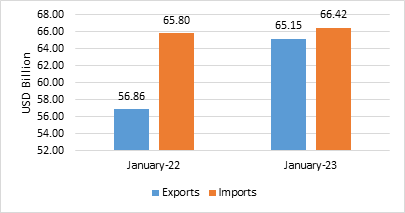
India’s overall exports (Merchandise and Services combined) in January 2023* are estimated to be USD 65.15 Billion, exhibiting a positive growth of 14.58 per cent over the same period last year. Overall imports in January 2023* are estimated to be USD 66.42 Billion, exhibiting a positive growth of 0.94 per cent over the same period last year.
Table 1: Trade during January 2023*
|
|
| January 2023 (USD Billion) | January 2022 (USD Billion) |
| Merchandise | Exports | 32.91 | 35.23 |
| Imports | 50.66 | 52.57 | |
| Services* | Exports | 32.24 | 21.63 |
| Imports | 15.76 | 13.24 | |
| Overall Trade (Merchandise +Services) * | Exports | 65.15 | 56.86 |
| Imports | 66.42 | 65.80 | |
| Trade Balance | -1.27 | -8.95 |
* Note: The latest data for services sector released by RBI is for December 2022. The data for January 2023 is an estimation, which will be revised based on RBI’s subsequent release. (ii) Data for April-January 2021-22 and April-September 2022 has been revised on pro-rata basis using quarterly balance of payments data.
Fig 1: Overall Trade during January 2023*
- India’s overall exports (Merchandise and Services combined) in April-January 2022-23 is estimated to exhibit a positive growth of 17.33 per cent over the same period last year (April-January 2021-22). As India’s domestic demand has remained steady amidst the global slump, overall imports in April-January 2022-23 is estimated to exhibit a growth of 22.92 per cent over the same period last year.
Table 2: Trade during April-January 2022-23*
|
|
| April-January 2022-23 (USD Billion) | April-January 2021-22 (USD Billion) |
| Merchandise | Exports | 369.25 | 340.28 |
| Imports | 602.20 | 494.06 | |
| Services* | Exports | pib.gov.in |
|
16 Feb, 2023

G-20 members stressed on increasing climate finance to help farmers take up adaptation measures, says Agriculture Secy. The G-20 members stressed on the need to increase climate finance to help farmers take up adaptation measures in order to mitigate the climate change impact on the farm sector, agriculture secretary Manoj Ahuja said on Wednesday. Addressing media on the concluding day of the G20 first Agriculture Deputies' Meeting here, Ahuja said: 'Climate finance was one of the issues which was discussed. The members felt that there was a need for an environment for increasing climate financing in terms of financing farmers for adaptation measures.' The member countries also suggested that farmers can be incentivised if they are adopting climate friendly farming or green agriculture. One of the ways was carbon credit, he said. The G20 nations also shared their experience on the impact of climate change in agriculture, he added. Climate smart agriculture was one of the four priority areas discussed in the first Agriculture Deputies Meeting. The secretary said: 'There was also discussion on the impact of climate change on agriculture and its productivity. We discussed how we can help save agriculture and make it sustainable.' India also shared the steps taken towards 'climate smart agriculture' like mapping the vulnerable areas and conducting research, he said. On the 'food security and nutrition' issue, Ahuja said, there was a discussion on achieving one of the Sustainable Development Goals (SDG) of 'zero hunger'. 'It has been seen that food insecurity has increased after 2018. This is a cause of concern. We discussed what best we can do to reduce hunger,' he said. On the third priority area of strengthening the value chain in agriculture, the secretary said there was a detailed discussion on improving the 'farm to folk' value chain in agriculture. India has already shifted its focus on production-centric approach to value-chain approach. On the fourth priority area of digital agriculture, he said India shared about the Agristack project that will help issuing farm advisories and move towards precision farming. 'Based on the outcome of this meeting, further discussions will continue in future meetings on agriculture to be held in Chandigarh, Varanasi and Hyderabad,' he added. The three-day event of the first G20 Agriculture Deputies Meeting of the Agriculture Working Group (AWG) concluded on Wednesday. Around 100 delegates, including representatives of international organisations like FAO, IFAD and IFPRI, attended the event. The secretary said 10 more countries will be invited in future meetings on agriculture. Source: economictimes.indiatimes.com |
|||
16 Feb, 2023

The 1st Agriculture Deputies Meeting (ADM) of the Agriculture Working Group under India s G20 Presidency concluded successfully today at Indore. The first Agriculture Deputies Meeting under the Agriculture Working Group (AWG), G20 spanning across three days, concluded today on 15th February, 2023.The event was an amalgamation of experiences rich in culture, cuisine, and history, and the greater responsibility of participating in meaningful deliberations during the meetings. Countries’ intervention on the proposed agenda by the Indian Presidency was well received and discussed. The final day of the event started with technical theme- wise sessions wherein, deliberations were held on four themes covering: 'food security and nutrition', 'sustainable agriculture with climate smart approach', 'inclusive agricultural value chains and food systems', and 'digitalization for agricultural transformation'. For discussion on technical session of Food Security and Nutrition, the opening remarks were delivered by Smt. Shubha Thakur, Joint Secretary, Department of Agriculture & Farmers Welfare (DA&FW) followed by context setting by World Food Programme (WFP). Dr. AbhilakshLikhi, Additional Secretary, DA&FW presented the Global Framework on Food Security and Nutrition, followed by an introduction to the Millet International Initiative for Research and Awareness (MIIRA) by Smt. Shubha Thakur, Joint Secretary, DA&FW. Sh. Franklin L. Khobung, Joint Secretary, DA&FW delivered the opening remarks for technical session on Sustainable Agriculture with Climate Smart Approach, followed by context setting by Food and Agriculture Organisation (FAO). Technical session on Inclusive Agricultural Value Chains and Food Systems was opened by Dr. AbhilakshLikhi, Additional Secretary, DA&FW and International Fund for Agricultural Development (IFAD) set the context for discussion. For technical session on Digitalisation for Agricultural Transformation, opening remarks were delivered by Dr. P.K. Meherda, Additional Secretary, DA&FW. The discussion context was set by ICRISAT. During each theme-based technical session, there was an open house discussion involving intellectually rich exchange of ideas, suggestions and observations. Insightful presentations paved way for agricultural transformation and importance of digitalization in agriculture with a special emphasis on smallholder farmers. The session co-chair Dr. SmitaSirohi, Joint Secretary, DA&FW, summed up each session, highlighting the concrete points made during the sessions. Concluding remarks and way forward was presented by the session chair Sh. Manoj Ahuja, Secretary, DA&FW emphasizing the need to have greater convergence and collaboration among the G20 member countries on agricultural research and development aspects. The chair assured to carry forward the discussions on G20 agricultural issues in the upcoming AWG meetings. The programme ended with a video showcasing the glimpses of the various events of the last 3 days, as a memoir for the participants to cherish their memorable visit to India. Source: pib.gov.in |
|||
16 Feb, 2023

Edible oil imports in Jan 2nd highest; record shipments of cooking oils in Nov-Jan. India's edible oil imports rose 33 per cent in January to 16.61 lakh tonnes, the highest since September 2021, driven by higher imports of sunflower oil, according to industry body SEA. Import of vegetable oils (edible and non-edible oils) in January rose 31 per cent to 16,61,750 tonnes from 12,70,728 tonnes in the same month last year. Edible oil imports rose to 16,61,750 tonnes in January -- the second highest monthly volume after September 2021 -- from 12,51,926 tonnes, while non-edible oil imports fell to nil from 18,802 tonnes, the Solvent Extractors' Association of India (SEA) said in a statement. The total import of vegetable oils during the first three months of the oil year 2022-23 (November-October) rose 30 per cent to 47,73,419 tonnes compared to 36,71,161 tonnes in the same period last year. Edible oil imports increased to 47,46,290 tonnes during November 2022-January 2023 period of the current oil year from 36,07,612 tonnes in the year-ago period, while shipments of non-edible oils fell to 27,129 tonnes from 63,549 tonnes. 'India's January sunflower oil imports surged to 4,61,000 tonnes, nearly triple average monthly imports as top exporters Russia and Ukraine seek to reduce stockpiles,' the SEA said. India's monthly sunflower oil imports averaged around 1,61,000 tonnes in 2021-22 oil year ended in October last year. 'The surge in sunflower oil and soyabean oil imports could dampen India's palm oil imports and weigh on palm oil prices,' the association said. SEA also expressed concern over the sharp increase in import of RBD (refined) palmolein in the first quarter of 2022-23 oil year at 6.30 lakh tonnes, nearly 20 per cent of total palm oil import, affecting domestic refineries. 'India's palm refining industry is heavily suffering from very low capacity utilization due to excessive import of RBD Palmolein and getting transformed into mere packers,' the association said. The duty difference between CPO (crude palm oil) and refined palmolein/palm oil needs to be increased from the current 7.5 per cent to at least 15 per cent by increasing RBD palmolein duty from current 12.5 per cent to 20 per cent without any change in CPO duty, it demanded. Source: economictimes.indiatimes.com |
|||
15 Feb, 2023

Andhra Pradesh: Mango yield likely to be above average season. There seems to be some good news for mango growers and lovers this season in many parts of the state. After two off years, this year there might be an above average yield. Owing to delay in flowering of mango trees and erratic weather conditions, the quality and quantity of mango dropped in many parts of the state in the last season. Last year, the yield was only six to eight tonnes per hectare as against the average 10-12 tonnes per hectare. Krishna, Annamayya, Chittoor and Vizianagaram districts in AP are home to one of the best mango varieties in the country, and top in export of the fruit. AP claims to be one of the largest producers of mango in the country. Additional director, horticulture, M Venkateswarulu, said if the dry weather continues till April, the yield might be over 12 tonnes per hectare this year. Compared to the previous year, the yield will be more this season. The bad weather conditions in December last year affected the flowering in some districts and overall, around 60 to 80 per cent of trees had the flowering this season as of now. In Krishna district, fruit setting has been witnessed, he added. Most of the mango growers in the state raise Banginapalli, China Rasalu, Pedda Rasalu, Totapuri, Neelam and Suvarnarekha varieties. One of the premium varieties from AP, and most suitable for exports, is Benishan or Banginpalli. There is also a demand for Suvarnarekha variety in the global market. 'We have observed that mango exporters prefer to procure the fruits grown in Annamayya district citing the high quality of the fruit and demand for the variety in global market,' said M Venkateswarulu. Quantity of exports depends on various factors. The mango growers and traders will get at least 30 to 40 per cent more revenue if their produce is exported to foreign countries when compared to domestic market, exporters say. AP exported over 1,600 metric tonnes of mangoes (Banginapalli, Rasalu and a few other varieties) to different countries in 2019. The Covid-19 hit the exports hard in 2020 and 2021. 'We are expecting the price of Banginapalli variety to touch at least 30,000 per tonne this season,' said G Ganesh, a mango farmer in Vizianagaram district. Source: timesofindia.indiatimes.com |