
Agriculture needs to be accorded top priority: Union Agriculture Minister.
Source: thehindu.com

India s overall exports in April 2023 estimated at USD 65.02 billion; a positive growth of 2 percent.
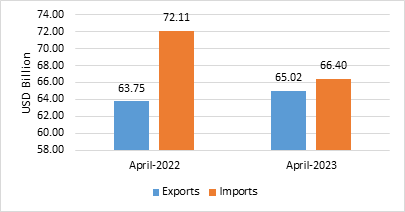
- India’s overall exports (Merchandise and Services combined) in April 2023* is estimated to be USD 65.02 Billion, exhibiting a positive growth of 2.00 per cent over April 2022. Overall imports in April 2023* is estimated to be USD 66.40 Billion, exhibiting a negative growth of (-) 7.92 per cent over April 2022.
Table 1: Trade during April 2023*
|
|
| April 2023 (USD Billion) | April 2022 (USD Billion) |
| Merchandise | Exports | 34.66 | 39.70 |
| Imports | 49.90 | 58.06 | |
| Services* | Exports | 30.36 | 24.05 |
| Imports | 16.50 | 14.06 | |
| Overall Trade (Merchandise +Services) * | Exports | 65.02 | 63.75 |
| Imports | 66.40 | 72.11 | |
| Trade Balance | -1.38 | -8.37 |
* Note: The latest data for services sector released by RBI is for March 2023. The data for April 2023 is an estimation, which will be revised based on RBI’s subsequent release. (ii) Data for April 2022 has been revised on pro-rata basis using quarterly balance of payments data.
Fig 1: Overall Trade during April 2023*
MERCHANDISE TRADE
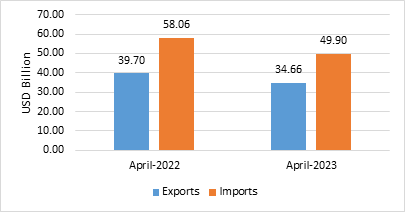
- Merchandise exports in April 2023 were USD 34.66 Billion, as compared to USD 39.70 Billion in April 2022.
- Merchandise imports in April 2023 were USD 49.90 Billion, as compared to USD 58.06 Billion in April 2022.
Fig 2: Merchandise Trade during April 2023
- Non-petroleum and non-gems & jewellery exports in April 2023 were USD 25.76 Billion, compared to USD 28.37 Billion in April 2022.
- Non-petroleum, non-gems & jewellery (gold, silver & precious metals) imports in April 2023 were USD 31.49 Billion, compared to USD 36.00 Billion in April 2022.
Table 2: Trade excluding Petroleum and Gems & Jewellery during April 2023
|
| April 2023 (USD Billion) | April 2022 (USD Billion) |
| Non- petroleum exports | 28.19 | 31.84 |
| Non- petroleum imports | pib.gov.in |
|
16 May, 2023

Next round of talks for India-UK trade agreement to be held in June. India and the UK will hold their next round of talks for the proposed free trade agreement in June here and both the sides are aiming to conclude the negotiations at the earliest, a senior government official said on Monday. Director General of Foreign Trade (DGFT) Santosh Kumar Saranagi said that trade negotiations are a matter of give and take and this has nothing to do with elections in individual countries. There will be general elections in India next year. 'The effort is to expedite the negotiations...(There was a) Diwali deadline (to conclude the talks last year) was given, but for variety of reasons, it was extended. But the effort on both sides is to conclude it at the earliest,' he told reporters here. The tenth round of negotiation is from June 5-9 here and 'hopefully we will make some substantial progress during that time,' he added. The negotiations were launched on January 13, 2021. The talks cover 26 policy areas/chapters. Investment is being negotiated as a separate agreement -- Bilateral Investment Treaty -- which would be concluded simultaneously with the India-UK free trade agreement (FTA). So far 13 chapters have been substantially closed for negotiations and regular meetings held at higher levels to review the progress of talks and to resolve the outstanding issues. He also informed that the fifth round of talks for a trade pact between India and the European Union (EU) is scheduled from June 19-23 in India. So far four rounds of negotiations have been completed till March. During the last round, negotiations on 21 policy areas in 74 technical sessions were held. Both sides also discussed modalities for exchange of offer in goods and services. India's commerce secretary and EU's DG (Trade) will meet in August to review the progress. About India-Canada trade agreement, the DGFT said that negotiations are at advance stage in goods and services market access. Seventh round of talks was held during April 3-6 in Ottawa, Canada. Apart from traditional areas, the interim agreement may cover areas like SMEs, trade and gender, environment and labour. On the comprehensive India-Australia agreement, he said that good progress was made in the agreed tracks and detailed work plan with indicative deadlines has been drawn up. It is envisaged by both the countries to hold the 3rd and 4th round of negotiations during 5th-16th June and 3rd-14th July, respectively, so as to pave the way for early conclusion of the negotiations. On the G20 talks, he said the second Trade and Investment Working Group (TIWG) meeting is now scheduled to be held on May 23-25 in Bengaluru. In dedicated technical sessions, G20 delegates will deliberate on priority on WTO (World Trade Organisation) reform along with key deliverables on identified priority issues on trade for growth and prosperity, resilient global value chains, integrating MSMEs in global trade, and efficient logistics for trade. The meeting will set the stage for building consensus among G20 countries on deliverables and outcomes proposed by India on global trade and investment-related issues. Source: economictimes.indiatimes.com |
||
15 May, 2023

India-EU trade, technology council first meeting at Brussels on May 16. The first ministerial level meeting of India-European Union Trade and Technology Council (TTC) will be held on May 16 in Brussels to discuss ways to increase cooperation in strategic technologies, digital connectivity, clean energy, trade and investments, an official statement said on Sunday. Commerce and industry minister Piyush Goyal is one of the co-chairs along with external affairs minister S Jaishankar and Union minister of state for electronics and information technology Rajeev Chandrasekhar, the commerce ministry said in a statement. The EU side is co-chaired by Executive Vice Presidents (EVPs) Dombrovskis and Vestager. It said that three working groups under the mechanism will report on roadmaps for future cooperation between the two sides -- Working Group on Strategic Technologies, Digital Governance and Digital Connectivity; Working Group on Green and Clean Energy Technologies; and Working Group on Trade, Investment and Resilient Value Chains. 'The first ministerial meeting will lay the roadmap for the cooperation under all three working groups and provide direction to achieve desired outcomes before the next ministerial meeting in the coming year,' it added. During the high level meetings with senior leadership of the European Union as well as Belgium various issues would come up for discussions and that include ongoing negotiations for Free Trade Agreement (FTA), addressing issues of mutual market access, reforms in the World Trade Organisation (WTO). The working group on trade, investment and resilient value chains is steered by the Department of Commerce and the first meeting of the working group was co-chaired by commerce secretary Sunil Barthwal and Sabine Weyand, Director General for Trade, from respective sides. Source: m.economictimes.com |
||
15 May, 2023

Significant rise . Edible oil imports rise 22% in first 6 months of current oil year. India’s import of edible oils increased by 22.29 per cent in the first six months of the oil year 2022-23 (November to October) following a significant rise in the import of palm oil and sunflower oil during the period. According to data available from the Solvent Extractors’ Association of India (SEA), the country imported 80.02 lakh tonnes (lt) of edible oil during November-April against 65.43 lt in the corresponding period a year ago. Palm products imports up BV Mehta, Executive Director of SEA, said the import of palm products (including crude palm oil and RBD palmolein) increased to 49.09 lt during November-April of the oil year 2022-23 against 30.92 lt in November-April of 2021-22. Attributing this increase to the price parity, he said the share of palm oil in the total edible oils increased to 61 per cent in the first six months of the oil year 2022-23 from 49 per cent a year ago. Import of RBD palmolein increased to 11.10 lt in the first six months of current oil year against 9.20 lt. Import of crude palm oil (CPO) stood at 37.61 lt against 22.62 lt. Stating that the share of RBD palmolein in the total palm oil import is around 22 per cent now, Mehta said India’s palm oil refining industry is heavily suffering from very low capacity utilisation due to excessive import of RBD palmolein. Sunflower oil shipments surge There has been a jump in the import of sunflower oil in the first half of the current oil year. India imported 13.67 lt of sunflower oil against 11.10 lt a year ago, recording a growth of 23.12 per cent. In fact, sunflower oil imports went up to 2.49 lt in April against 1.48 lt in March. Mehta attributed this to oversupply of the oil with international prices ruling lower compared to soyabean oil and CPO. The CIF import price of crude sunflower oil was $1,036 a tonne in April against $1,108 in March. In April, CIF import price of crude soyabean oil and CPO was at $1,049 a tonne and $1,039 a tonne, respectively. Soya oil imports slip However, there was a decline in the import of soyabean oil. India imported 17.25 lt of soyabean oil against 22.06 lt, recording a decline of 21.80 per cent. Indonesia and Malaysia were the major suppliers of RBD palmolein and CPO to India during the first half of the oil year 2022-23. Indonesia exported 17.24 lt of CPO and 8.77 lt of RBD palmolein to India during the first six months of the oil year 2022-23. This was followed by Malaysia at 12.98 lt of CPO and 2.05 lt RBD palmolein, and Thailand at 5.73 lt of CPO and 11,499 tonnes of RBD palmolein. India imported 9.53 lt of crude soyabean de-gummed oil from Argentina and 7.02 lt from Brazil during the period. During the first half of the oil year 2022-23, Russia exported 3.73 lt of crude sunflower oil to India. This was followed by Ukraine at 3.40 lt and Argentina at 1.06 lt. Source: thehindubusinessline.com |
||
15 May, 2023

India's recovery bright spot for global outlook: Nirmala Sitharaman. Finance minister Nirmala Sitharaman on Friday said India's strong recovery in the aftermath of the pandemic is a 'bright spot for the global growth outlook'. But at the same time she also underscored the dilemmas faced by emerging market developing economies between climate security and growth, as they manage 'overlapping crises and socio-economic transformation'. Addressing a G7 seminar on economic policies for welfare in Niigata in Japan, the minister stressed the need for balancing sustainable growth with environment in the short and long run. She also called for ways to measure 'empowerment going beyond indicators such as gross domestic product'. The minister is in Japan to attend the G7 meeting. India, which has the G20 presidency for the current year, is an invitee to G7 finance ministers and central bank governors (FMCBG) meeting. She also shared India's focus on digital public infrastructure and green hydrogen 'as a foundation for sustainable and inclusive growth and as an example of innovative policy toolkits' by emerging market developing economies, the finance ministry tweeted. Participating in the first session of FMCBG dialogue, Sitharaman highlighted the resilience as well as unique development challenges of emerging market developing economies. She called for bolstering cooperation among all stakeholders for timely resolution of the debt crisis being faced by vulnerable nations. In the second session of the FMCBG Dialogue focussed on sustainable growth, the minister underlined the need to bolster multilateral development banks to 'address trans-boundary challenges'. Source: m.economictimes.com |
||
15 May, 2023

With 6.9% year-on-year growth, goods exports rise to $451 billion in 2022-23. India’s goods exports for 2022-23 scaled up significantly from earlier estimates to almost $451 billion, indicating a 6.9% year-on-year growth, with exports for March upgraded sharply to a nine-month high of $41.9 billion, as per Commerce Ministry data. Initial estimates for the March had pegged exports at $38.38 billion, marking a sharp 13.9% decline, but revised numbers signal only a 6% contraction. The $41.9 billion exports made March only the second month of 2022-23 to cross the $40 billion mark after $42.3 billion in outbound shipments last June. The Ministry, which will be releasing the initial estimates for April’s merchandise trade on Monday, also revised March’s import bill to over $60 billion, the highest in 2023, raising its initial estimate of imports during the month by $1.9 billion. Remained unchanged However, the overall import bill for 2022-23 remained virtually unchanged at $714.04 billion, a 16.5% rise from 2021-22, compared to $714.24 billion reported initially. The rise in March’s import figure was largely offset by a $1.7 billion correction in November 2022’s import tally that was initially pegged at $58.2 billion, then revised upwards by half a billion dollars and finally pared to $56.95 billion. The latest revisions to official trade numbers cap off a year marked by what economists termed as significantly higher than usual variations between initial estimates and final numbers. Total exports were initially pegged at $447.46 billion as per data released on April 15, then revised to $444.2 billion as per a Ministry statement on May 1. That figure has now been raised to $450.95 billion. Similarly, the import bill as per the May 1 statement was pegged at $711.85 billion, from the initial estimate of $714.24 billion. Overall, export numbers were revised by over $25 billion from their initial estimates through 2022-23, with four months seeing a $3 billion-plus upward revision. The pace of these revisions has accelerated since November 2022, with exports etched up by an average $3.2 billion each month. The revision of $3.52 billion in March exports was the second highest in the year. Import figure revisions have only been slightly milder, averaging over $1.5 billion a month through 2022-23. Over $2 billion revisions from initial estimates were reported in four months, with December 2022 recording the highest upward revision of almost $3 billion. While experts have flagged petroleum shipments as the main driver for the extraordinarily high revisions of recent export data, the revision in import numbers needs further scrutiny. Source: thehindu.com |
||
15 May, 2023

Prime Minister Shri Modi's emphasis on the overall development of agriculture through technology - Shri Tomar. The 8th meeting of Agriculture Ministers of Shanghai Cooperation Organization (SCO) member countries was held today through video conferencing under the chairmanship of Union Agriculture and Farmers Welfare Minister Shri Narendra Singh Tomar. Russia, Uzbekistan, Kazakhstan, Kyrgyzstan, Tajikistan, China and Pakistan participated in it along with India. Under the chairmanship of India, SCO member countries adopted the Smart Agriculture project. Expressing satisfaction over the smart agriculture action plan and the initiative of innovation in agriculture, Shri Tomar said that Prime Minister Shri Narendra Modi's emphasis is on the overall development of agriculture in the country through technology. In this direction, India has taken several concrete steps to promote smart agriculture. Welcoming everyone to the SCO meeting on behalf of India, Union Minister Shri Tomar said that India gives importance to its relations with SCO in promoting multilateral, political, security, economic and people-to-people interactions. It is a matter of pleasure and pride for us to organize a meeting of SCO Agriculture Ministers to discuss strengthening cooperation in food security and nutrition, especially in the current situation. Shri Tomar said that in order to maintain the normal functioning of the food supply chain in the present conditions, there is a need for close contact and cooperation between various countries for food and nutrition security. He added that India is the largest employer globally in the agriculture sector, where more than half of our population is engaged in agriculture and allied sectors, while India also represents an important economic activity for many countries. Its importance is also evident from the fact that the budget allocation for agriculture and allied sectors in India has increased more than 5 times in 10 years from 2013-14. Over the years, India has performed well in the agriculture sector, contributing to global food security with food grain production, registering a significant growth in exports, and exports of agricultural and allied products have crossed Rs 4 lakh crore. Shri Tomar said that India's public distribution system and price support system for farmers are unique in the world. It is the good result of foresight of our policy-makers, efficiency of agricultural scientists and tireless hard work of farmers that today India is self-sufficient in food grains. India is a leading producer of many commodities like cereals, fruits, vegetables, milk, eggs, fish. He said that the welfare of the farmers and overall development of the agriculture sector has been the top priority of the Government of India. India, with its comprehensive development path in the agriculture sector, will continue to share its best practices and build capacities with other countries, bilaterally as well as in collaboration with international organizations, so that they too become self-reliant and food secure nations. He said that the rich agricultural research has played an important role in solving the issue of food security, improving the income of farmers and agriculture workers and also for the sustenance of the people. Efforts are being made by the Government of India to make the country self-reliant in the agriculture sector with concerted efforts in innovation, digital agriculture, climate smart technologies, development of high yielding, biofortified varieties, agricultural research. Efforts are being made to improve the life and livelihood of the farmers by making their agriculture sustainable and friendly. Referring to the country's very important Prime Minister Kisan Samman Nidhi scheme, Union Minister Shri Tomar said that under this, crores of farmers across the country would get Rs.6,000 per year are being given and so far about Rs 2.40 lakh crore has been deposited in the bank accounts of the farmers. Deposits have been made. Crores of farmers have been provided concessional institutional credit with a focus on extending Kisan Credit Cards to farmers and covering all PM-Kisan beneficiaries through these. Under the able leadership of Prime Minister Shri Modi, India is also promoting organic farming and natural farming with emphasis on sustainable productivity, food security and soil health. A plan has been started to promote and form 10,000 new Farmer Producer Organizations (FPOs) to increase the economic potential of small and marginal farmers by adding them to farmer groups. 1 lakh crore to develop infrastructure in rural areas. Agriculture Infrastructure Fund has been set up. India has taken several measures to increase the use of digital technologies in agriculture. National e-Governance Plan in Agriculture, Agristack and India Digital Eco-system for Agriculture etc., under which most of the schemes are being digitized and brought on a single platform, so that farmers can easily access these schemes and take benefits from them. He said that insurance cover is being provided to the farmers under the Pradhan Mantri Fasal Bima Yojana, under which Rs. are given. Electronic National Agriculture Market has been developed to increase market access of farmers. India has also launched programs to create new irrigation infrastructure, conserve soil fertility including balanced use of fertilizers, provide farm-to-market connectivity, ICT linkages, etc., with the goal of increasing farmers' income. The vision of empowering farmers, farm women, rural youth is being taken forward by taking large scale lab-to-land initiatives by developing new technologies and methodologies. In view of the importance of food-nutritional security and climate-friendly Mr. Anna, he also urged the SCO countries to support the International Year of Millets declared by the United Nations on India's proposal and said that India should achieve two sustainable development goals, that is, ending hunger, providing food Determined to obtain protection and nourishment. Bio-fortified varieties are a source of staple food rich in micronutrients and are being promoted continuously to address malnutrition in the country. At the beginning of the meeting, Shri Manoj Ahuja, Secretary, Union Ministry of Agriculture and Farmers Welfare gave a welcome address. Representatives of the SCO Secretariat as well as the Central Agriculture and high officials of the Ministry of Farmers Welfare and senior officials of SCO member countries participated. Source: pib.gov.in |
||
15 May, 2023

MoS Agri pitches for mass adoption of new farm technologies for achieving $5 trillion economy. Minister of State for Agriculture Kailash Choudhary on Friday said mass adoption of new technologies like drones, artificial intelligence (AI) and precision farming in the agriculture sector is essential for India to achieve USD 5 trillion economy milestone. '... we need to leverage new technologies, such as drones, AI, precision farming, blockchain in farming to achieve Prime Minister Narendra Modi's near future target of USD 5 trillion economy,' the minister said while addressing an event organised by agro-chemical firm Dhanuka Group. Choudhary also urged scientists to identify untapped areas, such as rain-fed districts to increase agriculture production substantially by empowering farmers with new agri technologies. 'The potential of most of the agri-land in the country has been exhausted, only the area dependant on rains is left whose potential needs to be tapped,' he said in a statement. Making a strong pitch for genetically modified (GM) crops, Deepak Pental, former Vice Chancellor, University of Delhi said, 'The USA has increased agriculture production by 35 per cent by introducing GM crops long back, whereas Europe just managed 6-7 per cent. 'The population in Europe is anyways not increasing, so they have the option, but do we have option? So, we need to decide which side of divide we want to be!' Pental, favouring the use of agro-chemicals, said that high-quality agro-chemicals are essential to reduce the damage to crops. Dhanuka Group Chairman R G Agarwal said, 'The government's forward looking policies towards new technologies and swift approvals for agriculture sector, clearance to drone guidelines being an example, are paving the way for Indian being food bowl for the world by 2047.' Source: m.economictimes.com |
||
15 May, 2023

Netherlands emerges as India's 3rd largest export destination. The Netherlands has emerged as India's third largest exports destination after the US and UAE during 2022-23, showed commerce ministry's data on Sunday. This can be attributed to a surge in shipment of goods such as petroleum products, electronic items, chemicals, and aluminium goods, reported PTI, citing commerce ministry. India's trade surplus with the Netherlands has also increased from USD 8 billion in 2021-22 to USD 13 billion in 2022-23. The Netherlands has taken over major destinations such as the UK, Hong Kong, Bangladesh and Germany, the data showed. India's exports to the Netherlands rose by about 48 per cent to USD 18.52 billion during 2022-23 as against USD 12.5 billion in 2021-22. In 2021-22 and 2020-21, the outbound shipments to the European country stood at USD 12.55 billion and USD 6.5 billion, respectively. The exports are registering healthy growth continuously since 2000-01, when India's exports to that nation was USD 880 million. Further, in 2021-22, the Netherlands was the fifth largest destination for Indian exports as against ninth in 2020-21. Federation of Indian Export Organisations (FIEO) Director General Ajay Sahai said the Netherlands has emerged as a hub for Europe with efficient port and connectivity with the EU through road, railways and waterways. In the calendar year, India's exports to the country increased to USD 18.1 billion in 2022 from USD 5.5 billion in 2017. According to economic think tank GTRI (Global Trade Research Initiative), ATF (aviation turbine fuel) and diesel were the key petroleum products exported from India to that country. Telecom equipment and smartphones with a value of over USD 1 billion were the largest electronic items, it said. Mumbai-based exporter and Chairman of Technocraft Industries Sharad Kumar Saraf said the trend would continue in the future also. Saraf said that the Netherlands is a gateway to Europe as their ports are very efficient hence cheaper than other European ports for shipping operations. India and the Netherlands established diplomatic relations in 1947. Since then, the two countries have developed strong political, economic and commercial relations. In 2022-23, the bilateral trade between the two countries increased to USD 24 billion as against USD 17 billion in 2021-22 and about USD 10 billion in 2020-21. The Netherlands is among top trading partners of India in Europe, after Germany, Switzerland, the UK and Belgium. It is also a major investor in India. During April-September this fiscal, India received USD 1.76 billion in foreign direct investment from the Netherlands. It was USD 4.6 billion in 2021-22. There are over 200 Dutch companies present in India, including Philips, Akzo Nobel, DSM, KLM and Rabobank. Similarly, there are over 200 Indian companies operating in the Netherlands, including all the major IT firms such as TCS, HCL, Wipro, Infosys, Tech Mahindra as well as Sun Pharmaceuticals and Tata Steel. Source: economictimes.indiatimes.com |