18 Oct, 2023
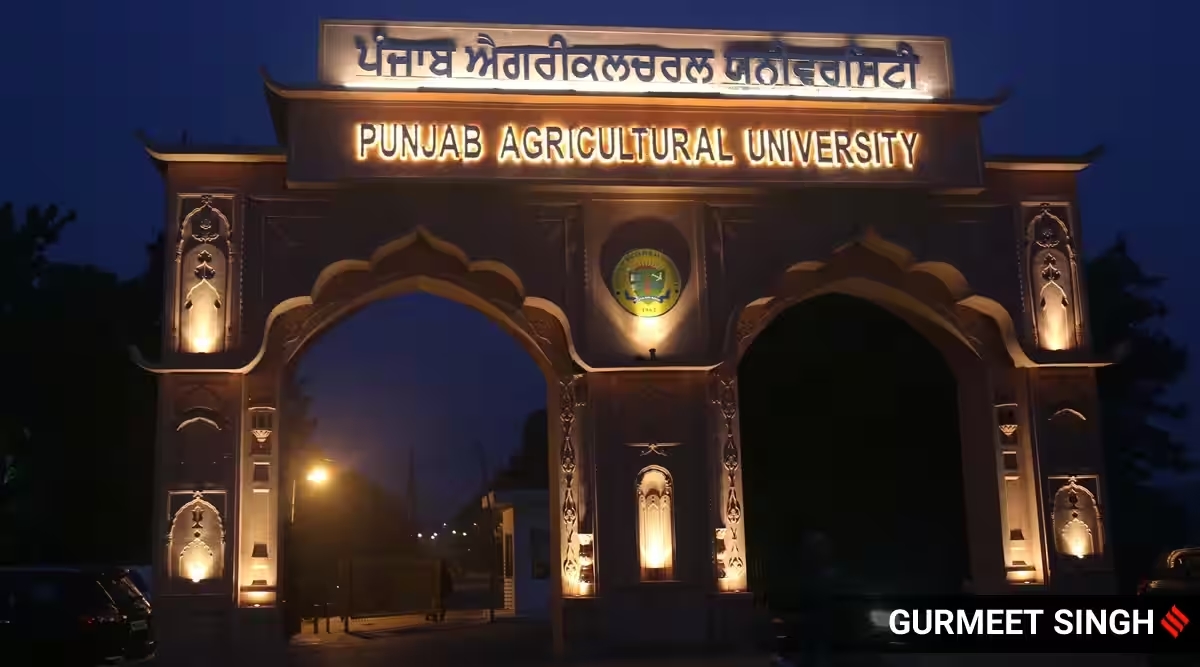
Asia s first agricultural museums conference begins at PAU.
The two-day Congress of the International Association of Agricultural Museums (CIMA), organised in collaboration with the Heritage Foundation, commenced at the Punjab Agricultural University (PAU) on Monday. World Food Prize winner Dr Gurdev Singh Khush, who was the chief guest at the opening ceremony, praised the university for hosting Asia’s first agricultural museums conference and underlined the tireless efforts of Punjab’s farmers and scientists in ensuring food security and reviving agriculture. Dr Khush highlighted PAU’s museums as tributes to the state’s agricultural heritage and culture, encapsulating the wisdom and efforts of the farming community. He traced the transformative impact of agriculture on human history, connecting societies and fostering the growth of civilisation. 'Museums serve as ideal platforms for preserving and showcasing diverse agricultural practices, tools, irrigation techniques, and crop cultivation methods through generations. Additionally, they facilitate research and collaboration, paving the way for revolutionary farming practices in the future,' he said. PAU Vice-Chancellor Dr Satbir Singh Gosal lauded the event as a significant milestone in promoting the cultural fabric of agriculture and underscored the vital role of agriculture in Punjab’s culture, emphasising how the university’s museums condense the intricate relationship between ecosystems, land, water, seeds, fertilizers, and sustainability. Professor Debra Reid, curator of Agriculture and Environment at the Henry Ford Museum, USA, discussed the significance of bringing the congress to India and highlighted the country’s growing importance in agriculture. She also noted the shift in the congress’s focus from primarily European to an increasingly Indian perspective. A book on the museums of PAU was also released during the event.
Source:
indianexpress.com
|
18 Oct, 2023

Georgia: Gateway Opportunities: The Port of Savannah s trade with India.
India represents enormous opportunities for Georgia’s Ports. The Georgia Ports Authority’s (GPA) overall trade with India grew faster than its trade with any other country among the top 20 over the past fiscal year. No other U.S. port expanded India trade by more containers than the Port of Savannah, by a margin of 14,000 twenty-foot equivalent container units, according to PIERS-Enterprise loaded cargo data. 'Our growth trajectory with India is extremely strong and we are actively taking steps to increase our presence in the market,' said Griff Lynch, GPA president and CEO. 'As production shifts to India and as demand in its economy rises, that trade increasingly favors the Port of Savannah’s strategic location over West Coast ports, due to time and cost.' Import-export volumes between Savannah and India totaled 279,149 TEUs last fiscal year, for an increase of 18 percent or 43,333 TEUs. Facts GPA exports to India grew by 50% in FY23 vs FY22 and by nearly 80% in the past five years. Overall GPA trade with the South Asian nation grew by 18% in the past fiscal year and 61% over the past five years. Savannah handles more India trade than any other U.S. port except NY/NJ. GPA imports from India over the past five years were up 52%. In FY23, imports constituted 63% of GPA’s total India volumes, signaling well-balanced trade. GPA has weekly container services with India’s major ports of Nhava Sheva (India’s commercial and financial hub – and largest port), Mundra and Pipavav. Quick stats on India India is the world’s fastest growing major economy and is expected to become the third largest economy by 2027. The median age is 28 in India vs. 38 in China. India’s global exports were one-tenth of China’s in 2021, but now exceed all other emerging markets except Mexico’s and Vietnam’s, according to World Bank data. India’s infrastructure is getting sweeping upgrades and the nation plans to invest $82 billion in port projects by 2035. Georgia’s ports and inland terminals support more than 561,000 jobs throughout the state annually, and contribute $33 billion in income, $140 billion in revenue and $3.8 billion in state and local taxes to Georgia’s economy. CNBC ranked Georgia #1 in the U.S. for infrastructure in America’s Top States for Business in 2023. GPA is investing in future supply chains with a $1.9 billion port master plan and a $6 million workforce housing initiative. The Port of Savannah is grateful and fortunate to have one of the most extensive, industry-leading supply chain ecosystems through our business partners operating near the port that serve the logistics needs of thousands of customers and ensure long-term competitiveness, business resiliency and future growth capabilities. For more information, visit gaports.com or contact Tom Boyd at tboyd@gaports.com or call (912) 964-3855.
Source:
allongeorgia.com
|
18 Oct, 2023
3-day workshop on millets in Lucknow from October 27.
The state government will felicitate the progressive farmers, primarily those engaged in cultivation of millets, during a three-day workshop scheduled to be organised in Lucknow’s Indira Gandhi Pratishthan between October 27 and 29. According to a state government spokesperson, farmers from six divisions -- Lucknow, Kanpur, Ayodhya, Basti, Azamgarh and Devipatan -- will participate on the first day of the convention titled Sri Anna Mahotsav and state level millets workshop. The event will be inaugurated by CM Yogi Adityanath. The second day will see participation by farmers from Saharanpur, Meerut, Aligarh, Agra and Moradabad. On the final day (29 October) farmers from Gorakhpur, Bareilly, Varanasi, Jhansi, Chitrakoot, Prayagraj and Mirzapur division will participate in the convention. The state government aims to bring in at least 50 progressive farmers from every district to the workshop. Besides this 10 representatives of Farmer Producer Organizations (FPO) and 10 technical assistants will participate in the conference. This comes ahead of the scheduled Krishi Kumbh scheduled in December. 'The government is encouraging farmers under Millets Year,' the spokesperson said. Besides, teachers and children of agricultural universities and two colleges will also participate in the workshop. The government will also create awareness about the production, consumption, marketing, export etc. of millets. As many as thirty five FPOs will be given certificates for seed money, the spokesperson said.
Source:
timesofindia.indiatimes.com
|
18 Oct, 2023
Global animal health body OKs India s bird flu self-declaration.
In a significant development that would open up new opportunities for Indian poultry in the global market, the World Organisation for Animal Health (WOAH) has approved the country's self-declaration of freedom from Highly Pathogenic Avian Influenza (HPAI), commonly known as bird flu, in specific poultry compartments (approved farms) in Maharashtra, Tamil Nadu, Uttar Pradesh, and Chhattisgarh. India is currently the third-largest producer of eggs (130 billion) and the fifth-largest producer of poultry meat (4.5 million tonnes) in the world. During the 2022-23 fiscal year, India exported poultry and poultry products to 64 countries, generating revenue of 134 million USD. Zoning and compartmentalization are strategic tools used to establish and maintain groups of animals with specific health statuses for the purposes of international trade and disease prevention or control. It involves defining a sub-population of animals with a specified health status within the national territory. 'The maintenance of this status relies on stringent management and husbandry practices that adhere to the standards outlined in the WOAH terrestrial code and recommendations related to specific disease chapters,' said a statement from the ministry of fisheries and animal husbandry that had submitted a self-declaration of freedom from (HPAI) in 26 poultry compartments in four states to the (WOAH). Referring to the approval that came on Friday, coinciding with World Egg Day, the ministry a day after said, 'This recognition by WOAH signifies India's commitment to international biosecurity standards and will contribute to enhancing the export potential of Indian poultry and poultry products, including meat and eggs.' Bird flu was first detected in India in Maharashtra in February 2006. Since then, the country has experienced its annual outbreaks in different regions, leading to substantial economic losses. The disease had been reported in 24 states and union territories, resulting in the culling of over 9 million birds to control its spread, in the past.
Source:
timesofindia.indiatimes.com
|
18 Oct, 2023
Paddy area breaches record 26.30-lh mark in Telangana.
Though late rains and dry spells were a cause of concern in the first few weeks of the kharif season, Telangana has registered a record paddy area of 26.30 lakh hectares (lh) as against a normal area of 20.17 lh. The area under paddy was 13.89 lh in 2014-15, the first kharif season after the State was formed. As per the Union Ministry of Agriculture, the kharif paddy acreage went up by 1.89 per cent to 411.95 lh compared to 404.27 lh during the same period last year. The present condition of the crop in some areas of the State, however, is said to be precarious. 'There is no rain for over a month now and water in smaller tanks is not enough to water the crops at this crucial stage of the crop. If there is no rain in the next one week, it might cause serious harm to the crop,' S Malla Reddy, a leader of Telangana Rythu Sangham, said. Millet, cotton area down This has resulted in a reduction in the area for millets and cotton. Redgram area is reduced to 1.91 lh against a normal area of 3.11 lh while the maize area fell to 2.13 lh against the normal area of 2.88 lh. The area of cotton fell to 18.11 lh against the normal area of 20.23 lh. According to the third Advance Estimates of Production of Food grains for 2022-23, rice production estimate was 175.27 lakh tonnes (lt) in the State. The Agricultural Market Intelligence Centre of Prof Jayashankar Telangana State Agricultural University (PJTSAU) forecast that Paddy-Grade-A and Paddy-Common could trade in price ranges of Rs.2,250–2,720 and Rs.2,185–2,250 a quintal respectively during October 2023.
Source:
thehindubusinessline.com
|
18 Oct, 2023
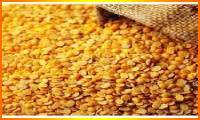
Indian importers allege tur dal cargo held ransom at Mozambique ports.
The pace of tur imports from Mozambique has slowed down significantly, resulting in slower correction in domestic tur prices. Indian importers alleged that more than 1.5 lakh tonnes of tur have been lying at the ports in Mozambique for more than a month as the exporters of that country are 'holding the tur cargo to ransom.' India has been facing shortages of pulses like tur, urad and masur. Although retail inflation eased to 5.02% in September, prices of pulses rose from 13% in August to 16.4% in September. Tur prices have stabilised following the recent government measure of tightening the stock limit on traders and processors. 'However, the prices of African tur, which have declined by 5%, could have reduced by another 10% if the imports had been smooth,' said a pulse importer from Maharashtra. 'Tur dal prices have been stable for some time. However, the prices of the African whole tur with skin, which were expected to decrease to Rs.75-80/kg, have only declined to Rs.90/kg from a high of Rs.95-96/kg due to slower pace of imports from Mozambique,' the importer added. 'Some the traders from Mozambique are trying to artificially increase the prices and block supplies to India.'
Source:
economictimes.indiatimes.com
|
18 Oct, 2023
Imported food item for re-export doesn't need clearance, says FSSAI.
The Custom authority does not need to send an imported food item for clearance to the Food Safety and Standards Authority of India (FSSAI) if it is meant for re-export or production of value-added items, which are only for exports, the authority has clarified. The clarification came after several business groups and industry associations approached the regulator in the view of objections raised in some quarters. The advisory should also facilitate ease of doing business. The FSSAI stated that consignments don’t need clearance if they are imported for use in a company’s sister concerns or wholly-owned subsidiaries, meant for 100 per cent export production. However, this is subject to a defined relationship agreement between the two entities and accompanied with a sanitary or health certificate issued by the competent authority of an exporting country. The food importers may take a self-declaration to the Customs authority, following which the concerned official may issue a ‘not in scope’ certificate to facilitate the import.
Source:
business-standard.com
|
18 Oct, 2023
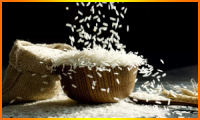
India to allow export of non-basmati white rice to some countries.
India will allow exports of non-basmati white rice to Nepal, Cameroon, Malaysia, Philippines, Seychelles, Ivory Coast and the Republic of Guinea, a government notification showed on Wednesday. India in July banned exports of non-basmati white rice and later imposed a 20% duty on exports of parboiled rice.
Source:
economictimes.indiatimes.com
|
17 Oct, 2023
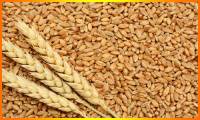
Maharashtra may cut area under chana and wheat, shift to maize and jowar.
Maharashtra, the second largest producer of chana and sixth largest for wheat in the country, plans to cut area under chana and wheat by 27% and 20% respectively during the rabi season. Instead, it plans to increase area of crops like jowar and maize, which need comparatively less water. Above-normal temperatures in October, low reservoir levels and chances of El Nino impacting the ensuing winter season have increased worries of farmers from rain-fed areas. Increasing area under jowar and maize would also help increase availability of fodder in rain-fed areas, where farmers have already started using sugarcane as fodder, said officials of the agriculture department. In its plan for the rabi season, Maharashtra's agriculture department has planned to reduce area planted under rabi chana to 21.52 lakh hectares, down from last year's chana acreage of 29.66 lakh hectares. The state government plans to reduce the area under wheat from 12.28 lakh hectares last year to 10 lakh hectares in 2023-24 rabi season. 'Instead of crops, which need more water, we plan to bring more area under millets like jowar and fodder crops like maize. Wheat needs around 4-5 rounds of irrigation, which may not be feasible in some areas,' said a high-level official of the state's agriculture department, requesting not to be quoted.
Source:
economictimes.indiatimes.com
|
17 Oct, 2023

Agricultural exports continue to grow during April -September 2023: Spices (1.35%), Fruits & Vegetables (10.67%), Cereal preparations & miscellaneous processed items (1.89%), Oil Meals (41.16%), Tobacco (7.6%), Oil seeds (23.47%), Coffee (3.43%), Cashew (0.31%).
- India’s overall exports (Merchandise and Services combined) in September 2023* is estimated to be USD 63.84 Billion, exhibiting a negative growth of (-) 1.20 per cent over September 2022. Overall imports in September 2023* is estimated to be USD 68.75 Billion, exhibiting a negative growth of (-) 13.67 per cent over September 2022.
Table 1: Trade during September 2023* | | | September 2023 (USD Billion) | September 2022 (USD Billion) | | Merchandise | Exports | 34.47 | 35.39 | | Imports | 53.84 | 63.37 | | Services* | Exports | 29.37 | 29.22 | | Imports | 14.91 | 16.27 | | Overall Trade (Merchandise +Services) * | Exports | 63.84 | 64.61 | | Imports | 68.75 | 79.64 | | Trade Balance | -4.92 | -15.03 | * Note: The latest data for services sector released by RBI is for August 2023. The data for September 2023 is an estimation, which will be revised based on RBI’s subsequent release. (ii) Data for April-September 2022 and April-June 2023 has been revised on pro-rata basis using quarterly balance of payments data. Fig 1: Overall Trade during September 2023* 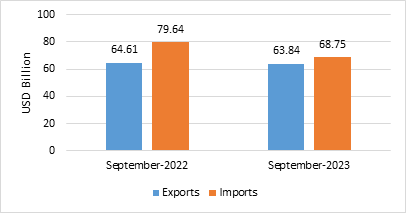 - India’s overall exports (Merchandise and Services combined) in April-September 2023 is estimated to exhibit a negative growth of (-) 2.97per cent over April-September 2022. Overall imports in April-September 2023 is estimated to exhibit a negative growth of (-) 10.14 per cent over April-September 2022.
Table 2: Trade during April-September 2023* | | | April-September 2023 (USD Billion) | April-September 2022 (USD Billion) | | Merchandise | Exports | 211.40 | 231.73 | | Imports | 326.98 | 372.56 | |
pib.gov.in
|
|