16 Oct, 2023
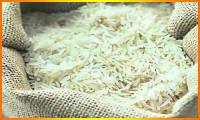
Export duty on parboiled rice extended upto March 31, 2024.
The government of India on Friday extended the export duty on parboiled rice till March 31 next year. The government in August had imposed a 20 per cent duty on the export of parboiled rice, a move aimed at maintaining adequate local stock and keep domestic prices under check. With these curbs, India imposed restrictions on all varieties on non-basmati rice. Non-basmati white rice constitutes about 25 per cent of the total rice exported from the country. Earlier, the government banned exports of non-basmati white rice to boost domestic supply and keep retail prices under check during the upcoming festive season. In September last year, exports of broken rice were prohibited. In the April-June period of this fiscal, about 15.54 lakh tonnes of non-basmati white rice was exported against only 11.55 lakh tonnes in the year-ago period. The ban on exports of non-basmati white rice was imposed due to the rise in prices of the foodgrain and higher exports. India's retail inflation eased to 5.02 per cent in September on an annual basis as against 6.83 per cent in August, showed data released by the ministry of statistics on Thursday. India's rice production is estimated to have risen to 135.54 million tonnes in the 2022-23 crop year (July-June) from 129.47 million tonnes in the previous year, according to the agriculture ministry data.
Source:
economictimes.indiatimes.com
|
16 Oct, 2023

16th Agricultural Science Congress Concludes.
16th Agricultural Science Congress (ASC) organised by the National Academy of Agricultural Sciences (NAAS) concluded today at Kochi. Secretary to the Department of Agricultural Research and Education and Director General of Indian Council of Agricultural Research (ICAR), Dr Himanshu Pathak delivered concluding remarks. He said that India’s agriculture has bright future with more youngsters coming to the sector with great fervour. Prizes distributed for the winners of the elocution contest held for university students on the occasion. The Congress discussed 10 thematic areas, including all issues related to agriculture and allied areas and sustainability issues on land and water, agricultural production systems, products, agricultural machinery, climate action, economics, renewable or alternative energy, precision farming, alternative farming systems, coastal agriculture, next-generation technologies, etc. As many as 114 papers were presented at the Congress. With a comprehensive agenda, the 16th ASC featured six plenary lectures by prominent figures in the field of agriculture and allied sectors. The Congress also hosted three panel discussions and four symposiums covering an array of topics. The Congress witnessed the convergence of over 1500 delegates from India and abroad. An Agri Expo held on the side-line of the event showcased innovative agricultural technologies of public and private sector research institutes, universities, agro-industries, extension agencies and NGOs.
Source:
pib.gov.in
|
16 Oct, 2023
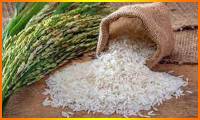
India may sell 1 mt of rice to help key partner Indonesia.
India may sign a memorandum of understanding (MoU) with its key diplomatic partner Indonesia to sell up to 1 million tonnes (mt) of white rice annually, two government officials said. India’s 20 July ban on non-basmati white rice exports comes even as Indonesia plans to safeguard food security against disruptions caused by the El Nino weather pattern and difficulties with supplies from Vietnam, the current major supplier. Although Indonesia is self-sufficient in rice production, it procures rice through MoUs when there is uncertainty in meeting its domestic demand. Currently, Indonesia has MoUs for the supply of white rice with Myanmar, Pakistan, Thailand, Cambodia and Vietnam. 'Indonesia is now facing difficulties as Vietnam, the current major supplier to the nation, aims to cut its rice exports significantly amid a drought forecast due to El Nino effects. To ensure meeting domestic demand, Indonesia is looking at India as an alternative supplier, and accordingly, the country has proposed an MoU for procuring up to 1 mt of white rice annually from India which is subject to availability.' one of the officials said. Although white rice export from India is currently under the prohibited category, exports permission can be granted by the government to meet the food security needs of other countries at the request of their governments. India earlier approved exports of limited quantities of rice to Bhutan, Mauritius, UAE, and Singapore. The UN’s World Food Programme also requested India to supply 200,000 tonnes after the ban. 'The proposed MoU doesn’t impose any kind of binding commitment on India to supply rice if domestic production is not favourable. The purchase is subject to production in both countries. Also, the proposed MoU clearly lays down that it does not create any obligation on either party under international law. It also includes termination of the MoU at any time by either party with a 6-month notice period,' the official explained. According to the commerce ministry, Indian exports of white rice to Indonesia in 2022-23 (April-March) was worth $1.05 million and $6.51 million till June in the current financial year. India’s share in Indonesia’s white rice import was 9.61% in 2020, 17.51% in 2021, and 7.06% in 2022. Therefore, 'the MoU may push India’s rice export to Indonesia when export conditions are favourable. It will also help increase India’s exports to Indonesia, diversify the trade basket and reduce the wide trade deficit,' the other official said. 'Further, the MoU will work in favour of India to get a foothold in the Indonesian market and emerge as an alternate supplier to Indonesia in place of Vietnam, Thailand and Pakistan, leading exporters after India. This will also help India to enhance its reliability among other Asean (Association of Southeast Asian Nations) rice buyers such as the Philippines and Malaysia,' the official said. Indonesia is India’s largest trading partner in the Asean region, with trade standing at $38.84 billion and accounting for a little over 29% in 2022-23 of India’s trade with Asean. With large palm oil imports from Indonesia, the trade deficit in the last financial year was $18.8 billion, according to commerce ministry data. 'The matter is still in an early stage, and will be taken to the authorities concerned before seeking approval from the cabinet committee,' the first official said. Queries sent to the spokespeople of the Indonesian embassy in New Delhi, commerce and food & public distribution ministries on Friday remained unanswered at press time.
Source:
livemint.com
|
16 Oct, 2023
Memorandum of Understanding signed between ICAR Indian Agricultural Research Institute and Indian Institute of Technology, Kanpur to support incubators and start-ups.
A Memorandum of Understanding (MoU) was signed today between Pusa Krishi, ICAR- Indian Agricultural Research Institute here and Start-up Incubation & Innovation Centre (SIIC), IIT Kanpur. The MoU was signed virtually by Dr. Viswanathan Chinnusamy, Joint Director (Research) IARI and Professor Ankush Sharma, Department of Electrical Engineering, SIIC IIT Kanpur. Through this MoU, both the sides will provide vital support to incubators and start-ups, fostering their growth and success. The joint efforts will offer a conducive environment for start-ups to thrive and make meaningful contributions to the agriculture sector. Pusa Krishi and SIIC IIT also expressed their commitment to explore and establish further collaborations to drive advancements and innovations in agriculture. Prof. Ankush Sharma expressed that the partnership will promote innovative activities in the farming sector through collaborative efforts, leveraging the expertise and resources of both the organizations. Dr. Viswanathan Chinnusamy said, 'In research, we need collaborations which further help our start-ups as well as incubators. I am glad today we signed a MoU with SIIC IIT.' Concluding the virtual ceremony, Dr Akriti Sharma said, 'If we want our start-ups to reach newer heights, make more profits, then we need support from tech-innovators like IIT Kanpur. This is just the beginning, in future, we will come up with such more collaborations with IIT Kanpur for overall development of agriculture sector.'
Source:
pib.gov.in
|
16 Oct, 2023
Centre considering review of Free on Board (FOB) value for issue of Registration cum Allocation Certificate (RCAC) for basmati rice by APEDA.
The Government has taken a series of measures in order to check the domestic prices of rice and ensure adequate availability for domestic consumers. One of the measures being that contracts for Basmati rice exports with the value of USD 1200 per MT and above only may be registered for issue of Registration – cum – Allocation Certificate (RCAC) effective from 25th August 2023. This measure was necessitated as the Government had received credible field reports regarding misclassification and illegal export of non-basmati white rice, exports of which have been prohibited with effect from 20th July 2023. It had been reported that non-basmati white rice was being exported under the HS code of Basmati rice. Now, the new crop of Basmati has started arriving and there is generally a decline in prices when the new crop starts arriving. Based on the representations received from the Rice Exporter Associations that the high FOB value is adversely affecting the export of basmati rice from the country, Hon’ble Minister, Consumer Affairs, Food and Public Distribution had attended a consultative meet with the basmati rice exporters. Based on the discussions in this meeting, review of FOB price of contract for issue of RCAC by APEDA for export of basmati rice is under active consideration of the Government. The present arrangement will continue until an appropriate decision is taken by the Government.
Source:
pib.gov.in
|
16 Oct, 2023

Global experts chart new directions for G20 countries to achieve women s empowerment and leadership in agri-food systems.
Strengthening women’s empowerment and leadership in agri-food systems is crucial to increase agricultural productivity, food security and nutrition, and resilience to climate change impacts. Global experts and researchers reached these conclusions at the close of the international gender conference From research to impact: Towards just and resilient agri-food systems, which took place in New Delhi on 9th-12th October 2023 and which was hosted by the CGIAR GENDER Impact Platform and the Indian Council of Agricultural Research (ICAR). These insights are particularly timely as they follow on the heels of the successful G20 Summit, during which G20 leaders committed to advancing women-led development and women’s leadership in food security, nutrition and climate action. The research-backed evidence presented during the conference is clear: Intentionally designing agricultural programs, projects, and policies to increase women’s empowerment leads to better outcomes for everyone, including increased agricultural productivity, better nutrition for children, improved dietary diversity as well as greater food security and climate resilience. Farmer Producer Organisations, or other types of collectives, were highlighted as a best-bet approach that can boost women’s access to markets, resources, agency and empowerment. Research also shows that fostering women’s leadership in all levels of innovation, decision-making and policy formulation is the only way to achieve just and resilient agri-food systems. Summarizing key insights from the conference deliberations, Assistant Director General (HRD), ICAR, Dr. Seema Jaggi said that G20 leaders agreed on four priority areas: investments in food security and nutrition, climate-smart approaches, inclusive agricultural value chains and digitalization for agricultural transformation. She said that CGIAR and ICAR can play a key role in informing these four priority areas. Country Representative for India and Research Leader of Gender and Livelihoods, International Rice Research Institute (IRRI), Dr Ranjitha Puskur said that A final call to action relates to stronger partnerships between researchers and research users. This week we are working with one of the largest national agricultural research systems in the world. We need to strengthen these partnerships as we cannot generate the evidence we need to be able inform policymaking without heavily engaging with the national agricultural research systems. Dr Puskur also highlighted the need for strengthening partnerships between researchers, policymakers, and the private sector. Speaking in the closing plenary session on Thursday were, in addition to Dr Puskur , Dr Jaggi and Senior Director of Program Quality and Partnerships at CARE USA, Dr Maureen Miruka, Dr Stefan Kachelriess-Matthess, Senior Programme Manager, GIZ and Senior Program Officer, Women’s Empowerment, Agriculture Development at the Bill and Melinda Gates Foundation, Ms Vicki Wilde.?As key development partners, they gave their perspectives on what is needed to move from research to impact, including renewed focus on designing agricultural solutions that consider the needs and constraints of women smallholders. The four-day international agricultural gender research conference, which comprised 4 plenary sessions, 54 parallel sessions, and 6 poster sessions, brought together delegates from more than 60 countries, deliberating how agricultural gender research can contribute to more resilient and just agri-food systems.
Source:
pib.gov.in
|
16 Oct, 2023
Ministry of Agriculture and Farmers Welfare is taking strategic steps and initiatives to ensure that the exponential growth in the Agri-tech sector is appropriately leveraged for the benefit of farmers across the country.
The agricultural sector in India is undergoing a remarkable transformation, driven by rapid advancements in technology and innovative practices. This evolution is further accelerated by the significant presence of Agri-Start-ups and private sector entities equipped with cutting-edge technological capabilities. The integration of a robust Digital Public Infrastructure, harnessing the potential of the Internet of Things, Artificial Intelligence, and Machine Learning, has already demonstrated promising outcomes in this domain. Additionally, the sector is witnessing the emergence of unique themes such as hyperspectral data analysis, photo-analytics, and the retrieval of precise weather parameters through geostationary satellites. Segmentation techniques and parcel-level crop mapping are providing unprecedented insights, thereby enhancing the efficiency and precision of agricultural practices. These collective advancements signify a pivotal moment in agriculture, ushering in an era of unprecedented productivity and sustainability. Consequently, the Ministry of Agriculture and Farmers Welfare is taking strategic steps and initiatives to ensure that the exponential growth in the Agri-tech sector is appropriately leveraged for the benefit of farmers across the country. In order to leverage these innovations, the Ministry of Agriculture and Farmers Welfare has constituted a screening committee that comprises experts in the field from esteemed institutions such as IITs, IIMs, IISc, IISERs, etc. This also has domain experts and experts from the industry. This committee will evaluate innovative solutions that directly impact the well-being of farmers. For this, the Ministry of Agriculture and Farmers Welfare has prepared a set of problem statements on which the proposals are being invited from the such interested entities. This has open an avenue for the entities who are working or willing to work in the agriculture sector and apply their innovative solutions to address the inherent challenges of the sector. The agri-tech sector has seen exponential growth over the last decade due to young talents who are earnestly working for the sector. One of the challenges faced by such entities is the lack of reliable data and strategic guidance from the sector. The Ministry of Agriculture and Farmers Welfare will shape and provide opportunities to all such entities by providing them the necessary support in the form of the ecosystem to pilot their solutions and perfect to effectively address the challenges If the solutions is innovative then these may be implemented at nationwide. The Ministry will invite Expressions of Interest (EoI), and proposals on the problem statements from Agri techs, start-ups, etc. to collaborate and share their expertise with the government. This inclusive approach seeks to facilitate a dynamic exchange of ideas and knowledge, ensuring a comprehensive approach to advancing the agricultural sector. The committee will seek presentations from potential collaborators, aiming to identify specific technologies and targeted interventions that align with the unique demands of the Indian agriculture landscape. Rigorous evaluation, including a comprehensive assessment of the concept, value proposition, and action plan, will be undertaken to gauge the feasibility and scalability of proposed initiatives. Based on this assessment, the committee will make informed recommendations, identifying suitable entities for collaboration with the Ministry. In certain cases, pro-bono partnerships may be encouraged, particularly for piloting innovations and subsequently scaling them up. Through these concerted efforts, the committee aims to drive significant progress and innovation in the agricultural domain, ultimately benefiting farmers across the nation. The interested entities may download the form, along with the problem statements and framework for leveraging innovations in the Agricultural Sector, which have been uploaded on the Ministry of Agriculture and Farmers Welfare website (www.agricoop.gov.in). The calendar for submissions of the proposal area as under: | Sr. No. | Critical Dates | From (Date) | To (Date) | Time | | 1. | Documents download | 12.10.2023 | 31.10.2023 | 1000 Hrs | | 2. | Proposal submission | 18.10.2023 | 07.11.2023 | 1500 Hrs |
Source:
pib.gov.in
|
16 Oct, 2023
Quality consciousness in the people will give a new direction to the country: Shri Piyush Goyal on the eve of World Standards Day.
Union Minister for Commerce and Industry, Consumer Affairs, Food and Public Distribution Shri Piyush Goyal has said that the quality consciousness in the people and awareness of the consumers of the country for quality, created through to the efforts of this government, will help give a new direction to the country. He was speaking on the eve of World Standards Day at the event, ‘Shared Vision for a Better World: Standards for Sustainable Development Goals, organized by Bureau of Indian Standards (BIS) at Bharat Mandapam in New Delhi today. Shri Goyal said that the mindset on quality brought about due to the vision of Prime Minister Narendra Modi is reflected in the world class infrastructure that is being created in the country, and Bharat Mandalam is a living example of this. He pointed out that the country earned a huge respect globally when it hosted the G20 Summit in this world class facility. Speaking on the initiatives of BIS, Shri Goyal said that there are over seven thousand BIS Standards Clubs today and about 2 lakh students have benefited from this initiative. He said that BIS has a target of establishing 10 thousand such clubs by next year. The new videos and books on quality issues that are being created, some of which were unveiled today, and the connect with the people till the level of Panchayats that is being attempted on these issues, will give rich results in days to come, he said. Shri Goyal pointed out that Department of Consumer Affairs touches the lives of each and every citizen of the country. The ecosystem of Standards has expanded in recent years to include almost all sectors including agriculture, roads, health care etc, all states and private sector, he said, adding that we will all work on the vision of zero effect, zero defect of Prime Minister to reach our goals. The event was also graced with the presence of Shri Ashwani Kumar Chaubey, the Hon’ble Minister of State for Consumer Affairs, Food & Public Distribution, Environment, Forest & Climate Change, Shri Rohit Kumar Singh, Secretary, Department of Consumer Affairs, Smt. Nidhi Khare, Special Secretary, Department of Consumer Affairs and Shri Pramod Kumar Tiwari, Director General, Bureau of Indian Standards. World Standards Day is observed every year on October 14th and highlights the collaboration between the leading International Standards Organizations. The chosen theme for World Standards Day in 2023 is 'Shared Vision for a Better World: Incorporating Sustainable Development Goal (SDG3) for Good Health and Well-Being.' SDG 3 aims to improve global health by reducing maternal and child mortality, combating major diseases, and ensuring access to essential healthcare services. It emphasizes universal health coverage and the importance of quality care without financial hardship. Through preventive measures, vaccinations, and better healthcare infrastructure, SDG 3 strives to create a healthier world that benefits individuals, communities, and nations. It also aims to provide access to safe, effective, and affordable medicines and vaccines for all. Achieving the goals of SDG 3 requires collaboration, innovative solutions, and addressing global health disparities. This theme highlights the importance of fostering a united vision to create a more sustainable and inclusive world that prioritizes the well-being and good health of all individuals. The event also serves as a platform to recognize the collective endeavours of countless experts worldwide who contribute to the field of standardization, while also providing an opportunity to reflect on the path ahead. The Bureau of Indian Standards (BIS) commemorated the World Standards Day by organising a wide range of consumer centric activities across the country through its robust network of regional and branch offices spread across India. The key activities conducted as part of the celebrations of the World Standards Day 2023 included - Quality Connect programs also known as Youth-to-Youth Connect, Manak Mahotsav, household connect, where they visited households to promote awareness about the BIS care app and BIS standards.
Source:
pib.gov.in
|
16 Oct, 2023
India s overall exports in September 2023 estimated at USD 63.84 Billion; Merchandise exports at USD 34.47 Billion in September 2023.
- India’s overall exports (Merchandise and Services combined) in September 2023* is estimated to be USD 63.84 Billion, exhibiting a negative growth of (-) 1.20 per cent over September 2022. Overall imports in September 2023* is estimated to be USD 68.75 Billion, exhibiting a negative growth of (-) 13.67 per cent over September 2022.
Table 1: Trade during September 2023* | | | September 2023 (USD Billion) | September 2022 (USD Billion) | | Merchandise | Exports | 34.47 | 35.39 | | Imports | 53.84 | 63.37 | | Services* | Exports | 29.37 | 29.22 | | Imports | 14.91 | 16.27 | | Overall Trade (Merchandise +Services) * | Exports | 63.84 | 64.61 | | Imports | 68.75 | 79.64 | | Trade Balance | -4.92 | -15.03 | * Note: The latest data for services sector released by RBI is for August 2023. The data for September 2023 is an estimation, which will be revised based on RBI’s subsequent release. (ii) Data for April-September 2022 and April-June 2023 has been revised on pro-rata basis using quarterly balance of payments data. Fig 1: Overall Trade during September 2023* 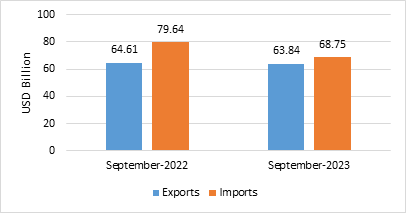 - India’s overall exports (Merchandise and Services combined) in April-September 2023 is estimated to exhibit a negative growth of (-) 2.97per cent over April-September 2022. Overall imports in April-September 2023 is estimated to exhibit a negative growth of (-) 10.14 per cent over April-September 2022.
Table 2: Trade during April-September 2023* | | | April-September 2023 (USD Billion) | April-September 2022 (USD Billion) | | Merchandise | Exports | 211.40 | 231.73 | | Imports | 326.98 | 372.56 | |
pib.gov.in
|
13 Oct, 2023
In five-year span, UP witness 250 times growth in export sector, says Yogi Adityanath.
In a convention of entrepreneurs held in Agra on Thursday under the aegis of the Laghu Udyog Bharati, Uttar Pradesh Chief Minister Yogi Adityanath extolled the success of his government, claiming that the state’s exports have increased by an unprecedented 250-fold in the last five years. Addressing the 1,500 entrepreneurs from 60 districts of UP, the chief minister said that he had the privilege of associating with Laghu Udyog Bharati for the third time in three months. 'Earlier, Laghu Udyog Bharti was also a partner in the trade show in Greater Noida, in which 500 foreign industrialists were also present, and the whole world saw the potential of UP in the field of industry,' he added. Adityanath pointed out that he got a chance to go to the International Expo in Bhadohi, where he realised that the entrepreneurs had been neglected in the state and were living in dismal conditions. 'India exports carpets worth Rs 17,000 crore every year, of which Rs 10,000 crore are exported from Bhadohi, Mirzapur, and Varanasi,' the UP CM added. He further stated that small-scale industry is the backbone of the economy, meeting all the standards of low expenditure, less space and environment, and creating more employment. 'Providing employment and economic self-reliance to more families can be done only through small-scale industry.' Highlighting the importance of small-scale enterprises, Adityanath said that with the blessings and inspiration of Prime Minister Modi, the work of reviving this sector was done through One District One Product (ODOP), in which efforts were made by the government to provide design, technology, packing, and market, which yielded good results. Referring to the new MSME policy of UP, he said that today, when an entrepreneur opens a new industry, he does not have to take any NOC for 1,000 days; he can first prepare his product as the state government has provided good infrastructure and there has been significant development in this sector. 'Work is progressing rapidly; global investment has begun in Uttar Pradesh, and the state has received investment proposals worth Rs 38 lakh crore, which will create 1 crore 10 lakh jobs for the youth in the state. Together with the central government, the UP government will take the country’s most populous state on a forward journey for which all the facilities under Ease of Doing Business will be provided to entrepreneurs,' he added. Speaking on the state government’s policy of zero tolerance towards crime, the chief minister said that the law and order system of UP has become an example, and his government will not allow anyone to play with the security of the state, 'no matter who it is.' 'If someone messes up, he will have to suffer the consequences. For the first time in the 2023 elections, law and order became an election issue, and the public was seen standing with the state government. We are getting immense support from the public on law and order,' Adityanath added. He assured the entrepreneurs present that the state government has many such policies that solve the problems of industrialists at the local level. In all the districts, a problem-solving system has been created with the district magistrate and SP along with the commissioner at the divisional level. 'Industrialists can get all their problems solved there. No entrepreneur should be worried.' He said that for the entrepreneurs who have registered in the GST, an insurance facility of Rs 5 lakh has been provided to industrialists; even if there is registration in MSME, there’s an insurance cover, and land banks have also been created. Inspiring the small entrepreneurs, the UP chief minister said that if they move forward in business with clear intentions and better communication, no one can stop Uttar Pradesh from moving forward in the field of industry. 'The double-engine government is standing with the industrialists with full commitment to their safety and security.'
Source:
theprint.in
|
|