
Bihar's 'khurma', 'tilkut','balu shahi' likely to get GI tags, applications accepted: Official.
Applications seeking geographical indication tag for 'khurma', 'tilkut' and 'balu shahi' - the famous delicacies of Bihar- have been accepted by competent authority after preliminary examinations, an official said on Saturday. Besides, similar applications for Hajipur's famous 'chiniya' variety of banana, Nalanda's popular 'bawan buti' sari and Gaya's 'Pattharkatti stone craft' have also been accepted by the GI registry, he said.
A GI tag identifies a product as originating from a particular region.
'Applications seeking GI tag for Bhojpur's Udwantnagar 'khurma', Gaya's 'tilkut', 'balu shahi' of Sitamarhi, Hajipur's famous 'chiniya' banana, Nalanda's popular 'bawan buti' sari and Gaya's 'Pattharkatti stone craft' have been accepted by the GI registry after crucial scrutiny and examination.
'These developments are very positive and encouraging. We are hopeful that all these will soon get the geographical indication tags,' the official said. ,' NABARD-Bihar chief general manager Sunil Kumar told PTI on Saturday.
Bhojpur's 'khurma' is liked by foreigners, while 'tilkut', a unique treat made from sesame seeds and jaggery, is quite popular outside the country.
'Balu shahi', a sweet delicacy of Runni Saidpur village of Sitamarhi, is also very popular in the country.
National Bank for Agriculture and Rural Development assisted producers' associations in filing applications for GI tags for these famous delicacies and products of Bihar, he said.
'We also engaged experts for the purpose. The bank is playing an important role in the GI registration process and also for marketing linkages, branding, and promotion of these items,' Kumar said.
GI tag for these delicacies and products will help farmers, manufacturers and artisans associated with these items earn more, he said.
Recently, GI tag was awarded to Bihar's famous 'marcha rice' which is famous for its aromatic flavour.
Bhagalpur's 'Jardalu mango, 'Katarni dhaan' (paddy), Nawada's 'Maghai paan' and Muzaffarpur's 'Shahi litchi' have already been protected under GI tag.
Source: economictimes.indiatimes.com
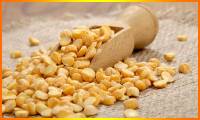
India unlikely to permit import of yellow peas.
The Indian government is unlikely to allow the import of yellow peas in view of a record high chana (gram) crop, despite reportedly being under pressure from trade lobby to allow its shipments.
The main reason for the Centre not permitting imports is that this year production of chana (gram) is estimated at 13.63 million tonnes, up from 13.54 mt last year.
Chana prices are ruling below the minimum support price (MSP) level of Rs.5,335 per quintal and the Centre is having to procure the pulses crop through Nafed to keep prices from falling further.
Allowing yellow peas import will further put pressure on chana and it is something the government does not want, said sources. They said recommendations to the government are to not allow imports of yellow peas for now.
Current prices
Currently, chana prices are ruling between Rs.4,700-4,800 per quintal. Interventions under the price support scheme are currently on and Nafed has procured about 11.68 lakh tonnes(lt) of chana as of April 20. Bulk of the chana purchases have been made from Maharashtra (4.93 lt), Madhya Pradesh (2.67 lt) and Gujarat (2.23 lt). However, the procurement is at a sluggish pace in Rajasthan, where the purchases are 10,839 tonnes. In Karnataka, 68,268 tonnes of chana has been purchased and 53,623 tonnes in Andhra Pradesh and 50,238 in Telangana.
Bimal Kothari, Chairman, India Pulses and Grains Association (IPGA), said the trade body has been urging the Centre to allow the import of yellow peas for quite some time now.
The latest representation was made in June-July last year, subject to conditions that the landed price of yellow peas be not below the MSP price of chana. Such a move will address the needs of farmers as well as consumers. Currently, yellow peas imports are in the restricted category.
Source: thehindubusinessline.com
NRRI submits proposals for identification of 10 new rice varieties.
The National Rice Research Institute (NRRI) has recently submitted proposals to the Central Varietal Release Committee (CVRC) for the identification of 10 new rice varieties, an official said. The institute's director A K Nayak said that seven rice varieties sent from NRRI were recognised by the CVRC in the last one year.
The institute will celebrate its 78th foundation day on Sunday, during which it will showcase its achievements so far.
This year's foundation day lecture has been named after the first director of the institute, K Ramiah, who was instrumental in identifying the site in Cuttack to establish the rice research centre in 1946.
Nayak said Ramiah's son R Pancharatnam has proposed to donate Rs 50 lakh to the institute for the endowment lecture.
Former NRRI director and Department of Agricultural Research and Education's ex-secretary Trilochan Mohapatra, who is presently officiating as chairperson of the Protection of Plant Varieties and Farmers' Rights Authority, will deliver the foundation day lecture on Sunday.
The NRRI director said the institute has been granted a patent for a 'method for albino free shoot regeneration in rice through anther culture'.
The institute has also filed for three patents and one provisional patent during the last one year apart from publishing 118 peer-reviewed articles.
Source: economictimes.indiatimes.com

Jamnagar to Kancheepuram: Mapping India s export hotspots.
Jamnagar in Gujarat is the top exporting district in India. It formed about 24% of India’s exports in value terms in FY23 (till January). Surat in Gujarat and Mumbai Suburban in Maharashtra feature second and third by a distance, forming only about 4.5% of the country’s exports in the period. The other districts in the top 10 are Dakshina Kannada (Karnataka), Devbhumi Dwarka, Bharuch and Kachchh (Gujarat), Mumbai (Maharashtra), Kancheepuram (Tamil Nadu) and Gautam Buddha Nagar (Uttar Pradesh).
For instance, Kancheepuram formed 33% of Tamil Nadu’s exports, the highest share among all the districts in the State. Some top exporting districts formed only around 20% of a State’s exports. For example, Indore and Jaipur, the top exporting districts in Madhya Pradesh and Rajasthan, respectively, formed only 21% of their State’s total exports each. On the other hand, most top exporting districts in the northeastern States formed as much as 90% of a State’s exports. Gomati (Tripura), Ri Bhoi (Meghalaya) and East Sikkim (Sikkim) formed over 90% of their State’s exports. Districts such as Dakshina Kannada, Gautam Buddha Nagar and Ernakulam formed about 40-50% of their respective State’s exports. In Map 1, the size of the circle corresponds to the district’s share in State’s exports. The bigger the circle, the higher the share of the district in the State’s exports.
Jamnagar’s dominance can be attributed to the fact that it formed a lion’s share of India’s surging petroleum exports, while Kancheepuram’s most exported commodity was smartphones. Map 1 also lists the top exported commodity of the top exporting districts in each State. For instance, Kamrup, Assam’s top exporting district, exported tea the most; Gautam Buddha Nagar in Uttar Pradesh exported smartphones the most; Raipur in Chhattisgarh exported parboiled rice the most; and Mumbai Suburban in Maharashtra exported diamond the most.
Map 2A shows the top five exporting districts of petroleum products in FY23. Jamnagar at first position is followed by Dakshina Kannada and Begusarai. Map 2B shows the top five exporting districts of precious stones and jewellery which includes Surat, Mumbai, Mumbai Suburban, Jaipur and Kolkata. Map 2C shows the top five exporting districts of rice, wheat and other cereals. Karnal leads the list, which also includes Raipur and East Godavari. Map 2D shows the top five exporting districts of smartphones and electronic parts. This list is led by Gautam Buddha Nagar followed by Kancheepuram, Kolar, Bengaluru Rural, and Kachchh. Map 2E shows the top five exporting districts of vehicles other than railways. Kancheepuram leads this list, which includes Pune, Gurugram, Anantapur and Aurangabad. Map 2F shows the top five exporting districts of pharmaceutical products: Medchal Malkajgiri, Ahmedabad, Ranga Reddy, Solan and Visakhapatnam.
Table 3
The table shows the share of the top exporting commodity of the top exporting district in India’s total exports
Commodity District State Share
Petroleum products Jamnagar Gujarat 67%
Precious stones & jewellery Surat Gujarat 36%
Smartphones, electronic parts Gautam Buddha Nagar Uttar Pradesh 26%
Vehicles Kancheepuram Tamil Nadu 21%
Rice, wheat & other cereals Karnal Haryana 17%
Pharmaceutical products Medchal Malkajgiri Telangana 15%
For instance, Jamnagar, Gujarat’s top exporting district, exported petroleum products the most. And Jamnagar’s petroleum products export formed 67% of India’s total exports for that commodity. Surat’s precious stones and jewellery exports formed 36% of India’s total exports for that commodity. Gautam Buddha Nagar’s smartphone exports formed 26% of India’s exports.
Source: thehindu.com
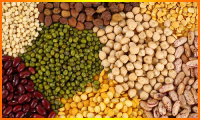
At $1.94 billion, India s pulses imports decline by 12.75% in FY23
After registering growth for four consecutive years, India’s pulses imports in terms of the rupee declined by around 5 per cent during the 2022-23 fiscal.
As per the Commerce Ministry’s quick estimates of major commodities, the value of pulses imported stood at ?15,780.73 crore during FY23 compared with ?16,627.58 crore in FY22. In terms of dollar, pulses imports were down by 12.79 per cent at $1.94 billion against $2.22 billion.
The decline in import value was likely on account of a dip in purchases of some pulses varieties such as as black matpe (urad), red kidney beans (rajma) and desi chickpea (gram). However, imports of tur and lentils increased. The Government is yet to release the quantitative import data for pulses.
Source: thehindubusinessline.com
NITI Aayog suggests states to formulate specific AgriTech policy to promote start-ups.
NITI Aayog has suggested states formulate their specific AgriTech policy to promote agriculture-based start-ups while enabling digitalisation of licensing regime, ensuring access of quality data and last mile connectivity to such start-ups to expand operations.
In its white paper on ‘Gearing Up To Solve Food Security Challenges’, the Aayog said that the agritech solutions available in the market are making the lives of smallholders better by improving access to quality input, access to market, reducing risks, access to information, and a host of other products and services, resulting in improved productivity and price realisation.
'Still, the agritech start-ups are not scaling up as fast as the start-ups in other sectors as they face challenges regarding access to quality data, regulations and the absence of agriculture-related infrastructure,' it said.
The white paper has been prepared by the Atal Innovation Mission under NITI Aayog in partnership with the United Nations Capital Development Fund (UNCDF) and supported by Rabo Foundation and Bill and Melinda Gates Foundation.
The Aayog has proposed half-a-dozen recommendations to help agritech startups in India to achieve their full potential and ensure food security in the country.
These include improving last-mile connectivity, access to public data, promoting local level of infrastructure for farm-level processing, digitalisation of licensing regime, formulating state-specific AgriTech policy and establishment of facilitation centre for agritech start-ups at local as well as global level.
'A distinct agritech start-up policy will go a long way in promoting and facilitating many such start-ups. It will also help the government departments work around the issues related to sharing of data, usage of data, and privacy issues by the private firms,' it said, adding these challenges are primarily related to regulations, understanding the market and its size and local facilitation.
Further, it has suggested setting up of a central body which will work with industry associations, respective embassies and multilateral organisations and promote start-ups to expand to other markets.
The Aayog is of the view that due to fragmented land parcels and many smallholder farmers in India, it is challenging for start-ups to reach out to individual farmers.
'To ensure that all smallholders can benefit from the services and products of the agritech startups, the government needs to put significant effort into building the capacity of local institutions like FPOs or cooperatives,' said, adding that these local institutions will act as a conduit between smallholders and start-ups.
Talking about the need for promoting local level of infrastructure, the Aayog said the government should promote the creation of local agriculture-related infrastructures by incentivising and providing financing from formal financial institutions. 'It will boost the farmers' income and ensure the start-ups' scalability and sustainability,' it added.
India has more than 2,000 agritech startups and the government aims to scale to 10,000 in near future.
Source: economictimes.indiatimes.com
FSSAI examining thousands of responses on the proposed health star rating norms for food products.
The recent Bournvita controversy has put the proposed norms in the spotlight amidst a larger health debate
The regulation proposes to rank food products from 0.5-5 stars based on their nutritional profile so that consumers can make informed decisions
The Food Safety and Standards Authority of India (FSSAI) is in the process of examining thousands of responses from various stakeholders that it has received on the proposed health star ratings regulations on the front of the packet of packaged food products. The latest controversy over brand Bournvita has triggered a larger health debate on social media. It has also brought the spotlight on the proposed health star rating (HSR) regulations.
A senior FSSAI official said, “We have received more than 12,000 responses and comments from various stakeholders. These responses have been sent to a scientific panel, which is examining it.”
The food safety authority had first proposed these norms in 2018 for high fat, sugar and salt (HFSS) products. The regulation proposes to rank food products from 0.5-5 stars based on their nutritional profile. The food authority issued a draft on health star ratings in September, 2022 to seek stakeholders’ comments.
Divergent views
The draft regulations have evinced divergent views. Health activists and NGOs have been in favour of implementation of these norms with some asking for even more robust warning labels for HFSS products. On the other hand, many domestic food companies, especially MSMEs, have been stressing that the HSR in its current form will adversely impact India’s traditional and ethnic food sector.
“In countries such as Australia, health star ratings have been implemented in the voluntary format. In Chile, such regulations are mandatory. We will examine all aspects. We will have a detailed discussions with all stakeholders before any decisions are finalised,” the FSSAI official stated. Once the regulations are finalised, they will be voluntary in nature for a period of four years, as per FSSAI’s proposal.
Source: thehindubusinessline.com
Wheat procurement tops 11 million tonnes, up 12% as grains pile up.
Wheat procurement in the current season was 11.14 million tonnes (mt) as of April 19, up by 12 per cent from 9.98 mt in the corresponding period last year as higher purchases were recorded in Madhya Pradesh, Haryana and Uttar Pradesh. The procurement in Punjab, the largest contributor to central pool stock, is lower so far, which may pick up after cover and plinth (CAP) storage has been allowed.
Nearly 12 lakh farmers have benefitted so far from the ongoing procurement season that started on April 1, with the expected outflow of ?23,663.63 crore at the minimum support price (MSP) of ?2,125/quintal.
As the harvesting started late this year due to unseasonal rains, farmers started bringing the crop only after it dried in the field, reducing moisture to normal, officials said. As Punjab has always seen arrivals improving after Baisakhi festival (April 14), this year, too, the daily arrivals which were 0.64 mt on April 16 increased to 0.72 mt on April 19. Millers said it would very soon go up to 1.5 mt per day.
Source: thehindubusinessline.com
14-countries, including India, look to wrap up Indo-Pacific Trade talks this year, Tai Says.
Negotiations over a US-led Indo-Pacific trade pact are likely to yield results this year, US Trade Representative Katherine Tai said.
Momentum is growing for the 14-nation economic initiative known as the Indo-Pacific Economic Framework for Prosperity, with the next round of talks set in Singapore in May, Tai said Thursday at a press conference in Tokyo.
The IPEF, launched last May during President Joe Biden’s trip to Asia, aims to strengthen US trade relationships in the region excluding China and is part of Washington’s efforts to counter Beijing’s growing global clout. The pact, which includes nations accounting for 40% of the global economy, demonstrates its trade commitment to the region, she said.
Source: economictimes.indiatimes
Seminars on sustainable agriculture, green wealth to be held today.
The District Environment Mission Team Rotary International District 3232 and Dr. M.G.R. Educational and Research Institute will jointly organise a seminar at the latter’s campus in Maduravoyal on Friday. A press release issued on Thursday said discussions on ‘Sustainable Agriculture and Talks on Sold Waste Management’, ‘People’s Participation in Environment Protection and Myths and Mists on Creating Green Wealth’ will be held on the occasion.
Source: thehindu.com