
India s overall exports projected to scale new heights, growing at 13.84 percent during FY 2022-23 over FY 2021-22 to achieve USD 770.18 billion worth of exports.
- India’s overall exports (Merchandise and Services combined) in March 2023* is estimated to be USD 66.14 Billion, exhibiting a negative growth of (-) 7.53 per cent over March 2022. Overall imports in March 2023* is estimated to be USD 72.18 Billion, exhibiting a negative growth of (-) 7.98 per cent over March 2022.
Table 1: Trade during March 2023*
|
|
| March 2023 (USD Billion) | March 2022 (USD Billion) |
| Merchandise | Exports | 38.38 | 44.57 |
| Imports | 58.11 | 63.09 | |
| Services* | Exports | 27.75 | 26.95 |
| Imports | 14.07 | 15.35 | |
| Overall Trade (Merchandise +Services) * | Exports | 66.14 | 71.52 |
| Imports | 72.18 | 78.44 | |
| Trade Balance | -6.04 | -6.92 |
* Note: The latest data for services sector released by RBI is for February 2023. The data for March 2023 is an estimation, which will be revised based on RBI’s subsequent release. (ii) Data for FY 2021-22 (April-March) and April-December 2022 has been revised on pro-rata basis using quarterly balance of payments data.
Fig 1: Overall Trade during March 2023*
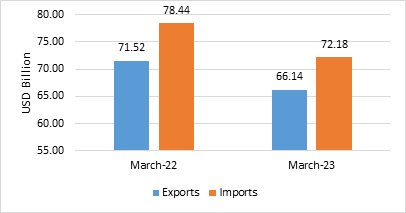
- India’s overall exports (Merchandise and Services combined) in FY 2022-23 (April-March) is estimated to exhibit a positive growth of 13.84 per cent over FY 2021-22 (April-March). As India’s domestic demand has remained steady amidst the global slump, overall imports in FY 2022-23 (April-March) is estimated to exhibit a growth of 17.38 per cent over FY 2021-22 (April-March).
Table 2: Trade during FY 2022-23 (April-March)*
|
|
| 2022-23 (USD Billion) | 2021-22 (USD Billion) |
| Merchandise | Exports | 447.46 | 422.00 |
| Imports | 714.24 | 613.05 | |
| pib.gov.in |
|||
17 Apr, 2023

India to Supply 10,000 Tonnes Wheat to Afghanistan. India has signed a memorandum of understanding (MoU) with the UN World Food Programme (WFP) for humanitarian food assistance of 10,000 tonnes of wheat for the people of Afghanistan reeling under a food crisis. The MoU marks the fifth tranche, to be shipped through the Chabahar Port, of humanitarian food assistance that India has committed. Last year, WFP arranged support for 23 million food-insecure people across Afghanistan following the contribution of 40,000 tonnes of wheat from India. The MoU was signed in Mumbai on Thursday between J P Singh, joint secretary, Pak-Afghan-Iran Division, ministry of external affairs, and Elisabeth Faure, representative and country director, World Food Programme in India. 'Sincere gratitude to the Indian government for food assistance to the people of Afghanistan. India's support has been a lifeline for families in need and is an important part of WFP's assistance to millions of people across Afghanistan,' said Faure. 'The fifth tranche builds upon assistance already delivered to those who need it most by WFP in Afghanistan. India has delivered on its commitment, ' Singh said on the occasion. Source: economictimes.indiatimes.com |
|||
17 Apr, 2023

Consultative Workshop on 'Technological Intervention & Innovations in the Honey / Beekeeping Sector'. Ministry of Agriculture and Farmers Welfare organized a Consultative Workshop on 'Technological Intervention & Innovations in the Honey / Beekeeping Sector' in New Delhi yesterday under National Beekeeping & Honey Mission (NBHM). Around 600 Beekeepers honey Startups/ FPOs, stakeholders in beekeeping, officials from various Ministries/ Government Organizations/ Institutes, State Departments of Horticulture, State Agricultural Universities (SAUs)/ Central Agricultural Universities (CAUs), etc. participated in the workshop physically and virtually. In the opening remarks of workshop, Dr. Prabhat Kumar, Horticulture Commissioner briefed about the status and scenario of beekeeping in the country. He highlighted the importance of technological interventions in beekeeping. He explained the role of National Beekeeping & Honey Mission (NBHM) and its contribution to strengthen the beekeeping sector, including provision of promotion of Honey FPOs and Agri startups through NBHM. He highlighted that implementation of NBHM scheme is also intended to strengthen the infrastructure facilities for honey collection, storage, processing, testing & branding centres, which ultimately enhance the export potential of honey in the nation. He also stated that GI Tagging may also become a great weapon to stop adulteration and malpractices in honey sector and encouraged the beekeepers/ stakeholders for getting GI Tagging & Geo referencing for their produce. He invited beekeepers/ other stakeholders to avail the facilities available under NBHM and to adopt beekeeping in a scientific manner to get additional income through honey & other beehive products. He assured full support to beekeepers across the country under the NBHM scheme. Dr. N. K. Patle, Additional Commissioner Horticulture and Executive Director, National Bee Board (NBB) has given a brief presentation on role and achievements under NBHM, GI Tagging/ Geo referencing of honey in the country, success stories of beneficiaries assisted under NBHM, opportunities for beekeepers, agristart-ups/ stakeholders under NBHM, etc. Addressing the participants in the workshop, he stated that technological interventions in beekeeping are very much required. He stated that Government is committed towards increasing the overall potential of beekeeping industry in the country including supporting the honey startups and FPOs in beekeeping. He mentioned that 31 Mini Testing Labs and 4 Regional labs have been sanctioned under NBHM to assure the quality of honey in the country Madhukranti Portal is another initiative under NBHM to capture the data on beekeeping through registration of beekeepers/ other stakeholders. He informed that NBHM is also supporting agri- entrepreneurs/ startups for their involvement in beekeeping/ Honey production. He mentioned that promotion & formation of FPOs is the first step for converting Krishi into Atmanirbhar Krishi and for this he assures that implementation of NBHM scheme will bring the revolutionary changes by strengthening the institutional framework in beekeeping sector and for formation & promotion of Honey FPOs and Honey Startups. He also invited all beekeeping stakeholders to come forward for obtaining GI tagging of their produce. Shri Samuel Praveen Kumar, Joint Secretary (Extension), DA&FW mentioned that for successful mission, infrastructure, innovations and technologically sound strategies must to be adopted to boost the sector. He also mentioned that the extension outreach of the mission to reach at ground level is another key for successful operation of the mission. Dr. Balraj Singh, Vice-Chancellor, SKN Agriculture University, Jobner, Jaipur, Rajasthan also interacted with the participants in the workshop and briefed about the role and support from Central and State Agricultural Universities for promotion and development of beekeeping sector. He stated that trainings & skill development and Bee breeding must be encouraged to strengthen beekeeping sector. Dr. V. Geethalakshmi, Vice-Chancellor, Tamil Nadu Agricultural University, Coimbatore, Tamil Nadu, also highlighted intervention of university and suggested measures to boost up the sector. Shri P. Chandra Shekara, Director General, MANAGE briefed about the potential of Agri Startups in beekeeping sector and mentioned that MANAGE is a one-stop solution for creating successful ventures in agriculture & allied sectors. He suggested working on literature on beekeeping and it must be available in different regional languages to make more outreach of the scheme. He suggested more capacity building program and setup ecosystem for startups and entrepreneurs in beekeeping sector. Shri Nirmal Vasrshney from Only and Surely Organic Products company, Haridwar, Uttar Pradesh also shared their experiences in beekeeping and guided beekeepers/ small entrepreneurs to expand their business and come forward for availing the assistance under NBHM. Shri Noor Mohamad Bhatt, Valley Apiaries & Food Products, Pulwama, J& K suggested for providing support to old beekeepers and adulteration in honey should be restricted. Shri Amit Dhanuka from Kejriwal Enterprises, New Delhi suggested regarding honey pricing stability and ask for awareness about the mustard honey crystallization and restriction on antibiotics in honey adulteration of C3 & C4 and antibiotics Shri Jayakumar, Director Marthandam Honey FPO, Kanniyakumari, Tamil Nadu stated that as GI tagging of honey will help to enhance the economic prosperity of producers of GI tag by enhancing their demand in national and international markets. He encouraged all the stakeholders involved in beekeeping to come forward for GI tagging of their produce. He also informed that he had applied for GI tag for Marthandam honey, which is under active consideration by respective authorities. Shri Nimit Singh from Madhumakkhi Wala, Barabank, U.P. introduced about their Honey startups and also encouraged the beekeepers/ other stakeholders to expand their profession by making honey-startups and availing assistance under schemes of Govt. of India. Dr. Arjun Singh Saini, Director General (Horticulture), Govt. of Haryana, suggested integrated way for beekeeping sector to produce quality honey, wax-sheet manufacturing in the area, and quality honey production as the lab is approved for national facility and it will be operational in a year. He also highlighted the issues related to trust between exports and beekeepers. So, the trade centers should be required to provide common platform. NBB should target long term vision for this sector and focus should be given to other beehive products and bee diagnostic should be setup. Shri Deepak Jolly, Secretary General, Indian Honey Alliance (IHA) informed that his organization will provide a unified platform to ensure maximum benefits to the beekeepers, consumers and development of value chain in honey sector. Shri Pankuj Prasad Raturi, Head Bio-Resource Development, Dabur informed that Dabur is procuring honey from diverse locations in India. He also informed that Dabur has started a great initiative to provide a new stream of income, and to alleviate poverty through the training and support of local NGOs in the practice of beekeeping in Bihar and Madhya Pradesh Has informed that, Dabur has planned the same in the Sundarban forest area of West Bengal as well. Shri Ramesh Mittal, Director, National Institute of Agricultural Marketing (NIAM), Jaipur, shared experience of start-ups in honey sector and given stress to promote honey sector. He suggested establishing Incubation Centre for Honey Sector as has been established under RKVY support. He has also extended support of NIAM for getting GI tag in Honey Sector with dedicated efforts. Dr Rajeev Chawala, NDDB informed about 1st honey testing lab setup by NDDB. He has suggested various ways to address issues of testing of honey. Dr. Umesh, DGM, APEDA briefly described about role of APEDA in export of honey and future strategies for its promotion. APEDA plans to create awareness among the stakeholders of food export by highlighting its impact on human life through various online platforms, including social media platforms. In his remarks, Dr. Abhilaksh Likhi, Additional Secretary, DA&FW has mentioned to focus on nurturing potential budding Agristart-ups & FPOs through support under NBHM scheme and motivate them to choose beekeeping as an attractive career. He assures that implementation of NBHM will upgrade skill in scientific beekeeping, setting up of state of the art infrastructural facilities for processing honey and allied beekeeping products like bee’s wax, propolis, royal jelly, bee venom, upgradation by quality control laboratories and create better supply chain by setting up of collection, storage, bottling and marketing centres. He also assures that collaborated approach of APEDA, MANAGE, NIAM, NAFED, NDDB, NBB and other related organizations will bring revolutionary achievements in beekeeping sector. He also stressed to start the awareness campaign through Mass Media on uses of crystallized honey that the crystallized honey is a pure/non adulterated honey. Indigenous Species of bees needs to evaluate for further region wise popularity. He emphasized that GI tagging in honey will help to boost rural areas by increasing revenue of the producers and employment in the region through beekeeping and honey production. The good quality of the products opens the international door for the producers thus help to boosts the exports of honey & other beehive products. Major suggestion received from the panelist and other participants of the workshops who highlighted to work on major action points like., technological interventions on traceability of Quality Honey, setup complaint Mechanism from exporters, create lab Infrastructure (should have adulteration and antibiotics test mechanism) along with the contact details. Participants also suggested some revisions of assistance under National Beekeeping & Honey Mission (NBHM). Components of NBHM like lab infrastructure to be improved, capacity building for honey bee keepers for addressing adulteration in honey, consumer outreach plan need to be prepared and more focus should be given to bee products. Source: pib.gov.in |
|||
13 Apr, 2023

Centre reviews status of stock disclosure of tur and urad. On Wednesday, the Secretary of the Department of Consumer Affairs, Rohit Kumar Singh, reviewed the stock disclosure status of tur and urad with major pulses producing and consuming states. Senior officials from Andhra Pradesh, Delhi, Gujarat, Karnataka, Madhya Pradesh, Maharashtra, Rajasthan, Tamil Nadu, and Uttar Pradesh attended the meeting. According to an official statement, the registered entities and disclosed stock quantities were reviewed individually with the States, and areas requiring attention were identified to ensure that entities like importers, millers, stockists, and traders disclose their stocks. While the number of entities registered in the stock disclosure portal has increased, it was observed that the actual number of stakeholders in certain States could be higher. The quantity of tur stocks disclosed as compared to production and consumption has also been found to be low in certain States. To widen the coverage of market players, State governments were asked to look into the data pertaining to FSSAI licences, APMC registration, GST registration, warehouses and custom bonded warehouses, the statement said. Last month, following a firming trend in prices of tur and urad, the Centre had directed the pulses trade to declare stock availability in a routine transparent manner. The imports of tur and urad are kept open till March 2024 to boost domestic supplies as output of these pulses during kharif 2022 was impacted due to erratic weather. The States informed that they are intensifying surveillance and shared the steps taken to ensure mandatory registration and disclosure of stocks on the stock disclosure portal. The States were directed to conduct verification of stocks held by various entities and take strict action on undisclosed stocks under relevant sections of the Essential Commodities Act, 1955 and the Prevention of Black marketing and Maintenance of Supplies of Essential Commodities Act, 1980. In order to assess the situation on the ground, the Department of Consumer Affairs has also deputed 12 senior officers to different State Capitals and Districts across major tur producing and trading centres to obtain ground level feedback from various market players, millers and storage operators. Source: thehindubusinessline.com |
|||
13 Apr, 2023

Export duty on husk rice scrapped. The central government has scrapped export duty of 20% on rice of seed quality in the husk (paddy or rough). Officials said the duty was scrapped after review of rice stocks. The exemption will be effective from April 11. The centre in September, 2022 had imposed an export duty of 20% on Rice in Husk (Paddy or Rough), Husked (Brown Rice) and Semi-milled or Wholly milled Rice. This was done to lower prices of rice and to make stocks available for the domestic market. The measures did not affect export of basmati or parboiled rice. Finance Ministry had said that changes in India’s rice-export rules have helped keep a check on domestic prices without reducing the availability for exports. Source: economictimes.indiatimes.com |
|||
13 Apr, 2023

Food processing industry in India- Current status, trend & opportunities. Food processing sector is sub-sector for the Indian Agriculture. India holds the number one position for producing spices, pulses, in milk productions & number two position for growing food grains such as wheat, rice, dryfruits, fruits, and vegetables. However, when it comes to the value addition and processing then we are far behind even in comparison with the small countries in the world. This sector is vital for the developing countries for job creation, reduce wastage, increase global trade, curb migration and most significantly providing better price realisation to farmers. Likewise any other sector, there were serious impacts of Covid-19 on food processing sector. The complete value chain was disturbed due to lockdown in many parts of the country. On the other hand, people have become more conscious about health, eating habits and products. They are also conscious about sugar, salt, adhesive, nutrition in the products. There is significant growth for natural ingredient products made from haldi, tulsi and other medicinal plants. There are no doubts that the trend will continue for next few years. Job creation in food processing industry: Ideally the growth in the food sector should directly help job creation. Small processing units setup in the rural part of India are helping generate jobs and lower migration to urban cities. As per 'Human resource & skill gap requirement report', 13.4 Lakhs job will be generated by the food processing industry from FY 2020 to FY 2023. The maximum jobs are created by a few sub-sector such as milling, dairy and aquaculture. Big organisations have a strong focus on automation processes. This is the reason that more than 60% of employment is generated by the medium and small enterprises in the food sector. • Ready-To-Eat (RTE)- food market in India is projected to grow by $751.43 million during 2022-2026, progressing at a CAGR of 18.63% during the forecast period. The market is driven by the growing preference for convenience food products in working population and expanding retail chain market in India. Both ready to eat and ready to cook have significant growth rate for next 5 years. Indian frozen foods market size has reached Rs 144.3 billion in 2022. Looking forward, the frozen food market will reach Rs 353.3 billion by 2028. The growth rate (CAGR) of 16% during 2023-2028. This segment is dominated the frozen vegetables and frozen meat. The Indian soup market is primarily driven by the urban consumer. This sector is projected to grow from Rs 7,230.8 million in 2019 to Rs 9,023.2 million in 2024 at a compound annual growth rate of 4.5%, says Global Data, a leading data and analytics company. Opportunities in Millet Products Development: United Nation has declared year 2023 Millet Year. India is world leader in millets production in the world with share of around 41% of total world production in 2020. India produces around 12 million MT of millets annually, according to Ministry of Agriculture and Farmers Welfare data. There are 3C benefits from the millets i.e a) Cultivation b) Consumer c) Climate Change. Looking from the consumer point of view, people are becoming aware of the health benefits of millets. It has opened up opportunities to develop different products from millets. Government Schemes & Subsidy: Government is aware about the importance and potential of the food sector. Considering it, they have already allowed 100% FDI permitted for food processing, 100% FDI under Government approval route for trading, including the same through e-commerce, with respect to food products manufactured and/or produced in India. There is flagship scheme under the Central Government umbrella with the total outlay of Rs 4,600 crore will continue till March 2026. • Integrated Cold Chain and Value Addition Infrastructure • Agro -Processing Cluster • Creation/Expansion of Food Processing/Preservation Capacities • Operation Greens • Scheme for setting-up/ up-gradation of Food Testing Laboratories Apart from Ministry of Food Processing and Industry, National Bank for Rural Development & Agriculture Processed Food Product Export Development Authority also has a number of schemes for the food processing sector and exporters. This incudes on-farm and off-farm projects such as for agri-infrastructure development, and dairy sector. Benefits of Free Trade Agreement (FTA): India has recently signed Free Trade Agreement with a couple of countries. This will help exporter to get more duty benefits and identify new market for products. However, its also important to identify competitors in the international market and follow labelling/packaging norms of the importing countries to avoid rejections. Action Plan – • Government should give more incentive to FPOs & SHG groups for setting up the small & medium processing units. • More collaboration is needed between industry & academic / research institution’s • Federation of FPOs should get more subsidy & credit guarantee from financial institutions • Synergies between State Governments & Central Government schemes All these measures can help to boost the sector. Source: fnbnews.com |
|||
13 Apr, 2023

India, France discuss progress on India-EU trade pact. Trade ministers of India and France have held discussions related to the ongoing talks for a free trade agreement between India and the European Union, the commerce ministry said on Wednesday. Commerce and Industry Minister Piyush Goyal was in Paris to attend India-France Business Summit and CEOs roundtable meet. He held bilateral meetings with several CEOs and French minister for Foreign Trade, Economic Attractiveness and French Nationals Abroad Olivier Becht. 'The ministers discussed priority areas related to India - EU FTA (free trade agreement) negotiations where issues related to market access were deliberated,' it said. Goyal also said India is looking to buy 2,000 commercial aircraft in the next 10 years and there is a huge opportunity to make commercial aircraft in India to meet domestic and international demand. With the purchase of Rafale and the recent Airbus order, more value has been added to this partnership, he added. In January last year, India and the EU resumed negotiations for a free trade agreement, investment protection and Geographical Indications (GI). Becht mentioned that bilateral trade was USD 15.1 billion in 2021-22, doubled in the last decade; and foreign direct investment (FDI) has been USD 10 billion from France which is a top foreign investor in India. There is a will from French companies to invest in India, he added. Goyal highlighted that by breaking language barriers trade can further be expanded. He also invited the French minister to India along with the French community on the sidelines of G20 Trade Ministers meet in August 2023. Goyal also addressed a CEOs roundtable meet on April 11. More than 50 CEOs from Indian and French companies participated at the roundtable. Sectors such as agriculture, tourism, defence, manufacturing, pharmaceuticals, textiles, aerospace were represented at the meet. Along with both the ministers, perspectives were shared by Ambassador of India to France Jawed Ashraf; Vice-President, CII and Chairman & Managing Director, ITC Sanjiv Puri; Executive Director, International Energy Agency Faith Birol; and CEO, Danone Antoine de Saint-Affrique. Source: economictimes.indiatimes.com |
|||
13 Apr, 2023

Tamil Nadu's Cumbum Grapes Secure Coveted GI Tag. Cumbum grapes just received the Geographical Indication (GI) label. This is the famous Cumbum Panneer Thratchai from Tamil Nadu, commonly known as Cumbum grapes. Additionally, Malai Poondu from Kodaikanal, Srivilliputtur Palkova and Palani Panchamirtham have also been awarded the GI tag. The Cumbum valley, located in Tamil Nadu's Western Ghats, is regarded as the "Grapes City of South India" and grows the Panneer Thratchai. This variety, sometimes known as Muscat Hamburg, accounts for over 85% of the grape-growing areas in Tamil Nadu. Theni district is one of Panneer Thratchai's highest grape-producing locations. However, the 'Panneer' type is most closely linked with Cumbum Valley, where the agricultural area spans over 2,000 acres across ten villages. The Cumbum region's agroclimate and soil conditions are ideal for the cultivation of the Muscat varietal. This cultivar is well-known for its rapid development and maturity. This ensures that the produce is available on the market nearly all year. The land's rich soil and water are considered to enhance the flavour of the natural fruit. Grape bunches range in size from medium to large and are compact in nature. The grapes grown can be used to make wine, spirits, jams, canned grape juice, and raisins. A French monk brought the Panneer grapes to Tamil Nadu in 1832. These grapes are high in vitamins, tartaric acid, and antioxidants, and they help to lower the risk of some chronic diseases. Apart from their purplish-brown color, they are also noted for their exceptional taste. Source: krishijagran.com |
|||
13 Apr, 2023

Madhya Pradesh: Sehore's Sharbati wheat gets GI tag. Madhya Pradesh’s popular Sharbati wheat, also called The Golden Grain, has bagged the Geographical Indication (GI) tag. Efforts were on to get it the GI tag for a very long time. While Sehore district is the largest producer of Sharbati wheat in the country, Madhya Pradesh is its largest producer and exporter. Flour made from Sharbati wheat is considered to be of the highest quality in the country. Farmers also get the highest level of prices for the most productive sharbati wheat in the district. As the name suggests, Sharbati variety wheat is slightly sweeter in taste probably due to the presence of slightly more amount of simple sugars like glucose and sucrose as compared to other wheat varieties. MP's handicrafts get GI Tag Recently, several handicraft products of Madhya Pradesh received the GI tags, including wrought iron crafts of Dindori, batik print of Ujjain, handmade carpet of Gwalior, stone craft of Bhedaghat in Jabalpur and handloom sarees and fabrics of Waraseoni. Source: freepressjournal.in |
|||
13 Apr, 2023

Centre relaxes wheat quality norms for Punjab, Haryana, Rajasthan. The Centre, after receiving inputs from its own team on the quality of wheat crop arriving in mandis/ procurement centres, has decided to relax the norms for Punjab, Haryana and Rajasthan with a nominal value cut, while a similar decision for Uttar Pradesh is expected in a day or two. Unseasonal rains and hailstorms in north west India during the second half of March has damaged the crop. The decision to relax norms is seen in the context of meeting the government’s own procurement target of 34.15 million tonnes (mt). Besides, it also helps the government thwart any political controversy after the Punjab cabinet passed a resolution urging the Centre to announce an immediate relaxation. 'There was no other alternative as it was already done for Madhya Pradesh, and any rejection of wheat citing non-conformance with standards, could have created unrest among farmers. Moreover, the government also wants to procure at least 29-30 mt of wheat,' said an official source. According to the Food Ministry’s three separate orders for Punjab, Haryana and Rajasthan, wheat should be procured at a relaxed norm with a value cut of Rs 5.31/quintal, from the minimum support price of Rs 2,125/quintal, if the grain has lustre loss of more than 10 per cent and within 80 per cent. There will be no value cut and MSP has to be paid in case lustre loss is up to 10 per cent. The Centre has also allowed relaxation for shrivelled and broken grains up to 18 per cent, with a value cut of up to Rs 32/quintal, against the current specification of 6 per cent in all the three states. 'Wheat having shrivelled and broken grains up to 6 per cent will be procured without a value cut. But for a subsequent increase of 2 per cent each in shrivelled and broken grains, the value cut will be Rs 5.31/quintal,' said an official. For instance, if shrivelled and broken grains make up 10 per cent of a 100 kg bag, a farmer will receive Rs 10.62/ quintal less than MSP, and in case it is 18 per cent, he will receive Rs 31.87/quintal lower. Haryana Chief Minister Manohar Lal Khattar and Deputy Chief Minister Dushyant Chautala have welcomed the Centre’s decision to relax the uniform specifications of wheat, but have requested the Centre to reconsider the value cut. The state government has also said that till the Centre takes a decision, Haryana will bear the amount of the value cut and farmers will receive the full MSP. The Haryana Bharatiya Kisan Union (Charuni) President, Gurnam Singh Charuni, had earlier demanded withdrawal of the value cut decision. The Punjab government has also welcomed the decision on relaxation. But unlike Haryana, it did not announce any relief on its own to compensate farmers on value cut. Punjab Food Minister Lal Chand Kataruchak was not available for comment. Source: thehindubusinessline.com |