
India-UK FTA talks: Good progress on rules of origin, bilateral investment treaty.
Source: economictimes.indiatimes.com

India exporting wheat, rice to needy countries for their food security.
Source: economictimes.indiatimes.com

India, Brazil begin talks to resolve sugar related trade dispute at WTO.
Source: economictimes.indiatimes.com

Assam signs MoU with QCI to improve food safety ecosystem.
Source: fnbnews.com

Govt launches unified portal for agri-statistics to provide credible data on agri sector.
Source: economictimes.indiatimes.com

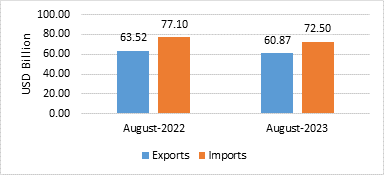
India s overall exports in August 2023 estimated at USD 60.87 Billion; Merchandise exports estimated at USD 34.48 Billion in August 2023, despite global sluggish growth.
- India’s overall exports (Merchandise and Services combined) in August 2023* is estimated to be USD 60.87 Billion, exhibiting a negative growth of (-) 4.17 per cent over August 2022. Overall imports in August 2023* is estimated to be USD 72.50 Billion, exhibiting a negative growth of (-) 5.97 per cent over August 2022.
Table 1: Trade during August 2023*
|
|
| August 2023 (USD Billion) | August 2022 (USD Billion) |
| Merchandise | Exports | 34.48 | 37.02 |
| Imports | 58.64 | 61.88 | |
| Services* | Exports | 26.39 | 26.50 |
| Imports | 13.86 | 15.22 | |
| Overall Trade (Merchandise +Services) * | Exports | 60.87 | 63.52 |
| Imports | 72.50 | 77.10 | |
| Trade Balance | -11.63 | -13.58 |
* Note: The latest data for services sector released by RBI is for July 2023. The data for August 2023 is an estimation, which will be revised based on RBI’s subsequent release. (ii) Data for April-August 2022 has been revised on pro-rata basis using quarterly balance of payments data.
Fig 1: Overall Trade during August 2023*
- India’s overall exports (Merchandise and Services combined) in April-August 2023 is estimated to exhibit a negative growth of (-) 5.22 per cent over April-August 2022. Overall imports in April-August 2023 is estimated to exhibit a negative growth of (-) 10.35 per cent over April-August 2022.
Table 2: Trade during April-August 2023*
|
|
| April-August 2023 (USD Billion) | April-August 2022 (USD Billion) |
| Merchandise | Exports | 172.95 | 196.33 |
| Imports | 271.83 | 309.19 | |
| Services* | Exports | pib.gov.in | |
18 Sep, 2023

Impasse over dispute settlement system likely to end: WTO deputy director-general Angela Ellard. World Trade Organization (WTO) deputy director-general Angela Ellard said negotiations are on to resolve the impasse about the dispute settlement system, to make it fully functional and accessible to all by 2024. She also said WTO's dispute settlement mechanism 'created a path' for India and the US to mutually resolve their disputes. 'The resolution of the US-India disputes is a very welcome development. I think the dispute settlement mechanism here in the WTO created a path for that resolution,' she said, adding that these are all examples of how having a dispute settlement system helps members resolve their conflicts. The US and India have agreed to resolve their seven outstanding disputes at the WTO. These related to poultry imports from the US, countervailing measures on certain hot-rolled carbon steel flat products from India, certain measures related to solar cells and modules, measures related to the renewable energy sector, India's export-related measures, certain measures on steel and aluminium products and additional duties on some products from the US. On the Multi-Party Interim Appeal Arbitration Arrangement (MPIA), which is an alternative system to resolve WTO disputes, she said: 'It's my observation that members haven't said that we have the MPIA, so we don't need to worry about reforming the system.' Her statement assumes significance as WTO reform takes centre stage ahead of the 13th ministerial conference next year. MPIA has 30-odd members at present. Indian officials have said it is the country's principled stand to not go to the MPIA. There is no Appellate Body Division available at present to deal with the appeals due to the ongoing lack of agreement among WTO members on the filling up of vacancies in the body. Hence, all appeals are considered an 'appeal into the void'. India has suggested 34 operational changes to the WTO, such as putting in place a 12-month cooling-off period before hiring any ambassador to the WTO in any roles in the organisation, resolving old issues before adding new ones, and a time-bound work programme to make dispute settlement more accessible for the developing countries. 'With respect to reform more broadly, it covers a variety of issues. It includes processes and procedures...but in addition to the procedural issues, there is also a big discussion about what the WTO should be doing on some substantive issues that are the most compelling issues of our time,' Ellard said. Source: economictimes.indiatimes.com |
|||
18 Sep, 2023

Basic customs duties on 8 US products will continue; only retaliatory tax removed. The basic customs duties and other levies will continue on eight products, including apple and walnut from the US as well as other countries, a senior government official said on Friday. Additional Secretary in the Department of Commerce Peeyush Kumar said that India has imposed retaliatory customs duties on 28 American products in 2019 against US measure to imposes duties on certain steel and aluminium products. He added that India has withdrawn only retaliatory duty on these eight products -- chickpeas, lentils, almonds, walnut, apple, boric acid, diagnostic reagents -- in 2023 and its value of imports into India from the US stood at USD 1.08 billion in 2022-23. In return, India has gained market access for indefinite period into the US through commitments for granting approval to 70 per cent and 80 per cent of exclusion requests, respectively, for Indian steel and aluminum products. Total volume approved is 3.36 lakh MT (metric tones) and its total value is USD 1.01 billion, Kumar told reporters here. 'The existing BCD (basic customs duty) rates for all the 8 products along with applicable surcharge, cess, IGST, etc. prevails for these imports from all the countries including the US,' he said. In addition, he said, Indian apples would be shielded against dumping of low quality and predatory pricing through the Minimum Import Price (MIP) of Rs 50 per kilogramme for imports from all countries except Bhutan. The retaliatory duties removed are 10 per cent on chickpeas, 20 per cent on lentils, Rs 7-20 per kg on almonds,; and 20 per cent each on walnuts, apple, boric acid, and diagnostic reagents. The BCD on these goods are 60 per cent on chickpeas, 30 per cent on lentils, Rs 35-100 per kg on almonds, Rs 100 per cent on walnut; 50 per cent each on apples, 7.5 per cent on boric acid, and 10 per cent on diagnostic reagents. Source: economictimes.indiatimes.com |
|||
15 Sep, 2023

Bangladesh: Traders want to import eggs, meat. They recently applied to the Ministry of Commerce seeking permission to import these products. Importing companies say if they bring this product, the price will decrease in the market. As the production of meat and eggs has increased in the country, the prices have also increased accordingly. Farmers and traders demanded that the price of the products be fixed, but it is not working. According to the application submitted to the ministry, 'The price of beef and protein has increased due to the increase in the price of cow feed and syndicates of dishonest traders. If this situation continues, buying beef will be beyond the reach of the common people of the country.' Even two years ago, beef was sold at Tk 500 per kg, now the price is Tk 700-800. The country is producing 8.44 million tonnes of meat annually, which is insufficient compared to the demand. The price of beef is gradually increasing. If this continues, the people of the country will have to buy beef for Tk 1000 per kg. Therefore, to control the market price and keep the product price under control, beef and buffalo meat must be imported, the application reads. Taking these matters into consideration, Ripa Enterprise, an importing company wants permission to import 2,000 tons of beef and buffalo meat. The supply of eggs in the country is insufficient compared to the demand. Although the country has a daily demand of 4.5 crore pieces of eggs, now the production is 2 crore pieces, according to another application to the ministry. As a result, the shortage is 2.5 crore pieces per day, 75 crore pieces per month, and 27,375 crore pieces of eggs per year. Importer Tiger Trading says the production is grossly insufficient to meet the country's overall nutritional needs. The recent rise in egg prices has put consumers under financial stress and a nutritional crisis. In this situation, Tiger Trading has asked for permission to import 100 million pieces of eggs annually in limited form, the application reads. Earlier, in November 2022, a total of six importing companies, including Tiger Trading and Ripa Enterprises, applied to the Ministry of Commerce for permission to import 51 crore eggs citing the country's egg shortage and high prices. Fisheries and Livestock Minister SM Rezaul Karim said in this regard. 'Market management is responsible for increasing the price of beef and eggs. Even after meeting the country's needs, there are still enough surpluses. For this, the government has planned to export. Various facilities are being provided for farm expansion to increase production in the country. A new Dairy Development Board is being set up. So, there is no situation to import meat and eggs.' Commerce Secretary Tapan Kanti Ghosh spoke at an event in favour of importing beef from abroad on August 25. However, beef is not being imported to protect domestic producers, he said. If beef is imported from Brazil-Argentina, consumers will get the beef at Tk 350 to Tk 400 per kg. Now they have to buy this meat for Tk 800, he added. Experts say marginal farmers will be the most affected. In addition to collapsing the rural economy, public health will be threatened. For this, they demanded to determine the reasonable price of the two products. In 2015, the Indian government took a strict stance on the entry of cattle from India to Bangladesh. Since then, it has become possible to meet the demand of the country's farmers and farmers for Eid sacrifice with cows. Farmers are still bearing the burden of losses as there are 24 lakh 94 thousand 521 sacrificing animals that remained unsold in the last Eid-ul-Adha. According to the data of the Bangladesh Dairy Farmers Association and Department of Livestock (DLS), Bangladesh boasts approximately 1.2 million farms, providing employment opportunities for a staggering 9.4 million individuals. According to DLS 2023 data, meat production was around 9 lakh tonnes in 2001-02, followed by around 93 lakh tonnes in 2021-22. Meat production has increased by about 156 per cent in 10 years. An 8.44 million tonnes of meat is being produced against the demand of 7.4 million tonnes. As a result, meat import was imposed last year. Not only that, an initiative has also been taken to export meat from the Ministry of Fisheries and Livestock. According to the data of Chattogram Custom House, the import of boneless frozen bovine meat was 974 metric tonnes in 2022-23. The import value of these products is Tk 44 crore. In the previous fiscal year (2021-22), this product was imported at a cost of Tk 577 of 13,206 tonnes. That is, 12232 metric tonnes or 93 per cent less imported frozen boneless bovine meat has been imported in one year. Mentionable, frozen meat is imported from India, Thailand, Korea, Australia, United Arab Emirates, Vietnam, Malaysia and Japan through Chattogram Sea Port. Insiders say unable to import raw meat, now processed meat packets are being brought and sold to restaurants. Processed meat from India is regularly cooked in hotels and restaurants in the capital Dhaka. The country produces 6.38 crore eggs per day while 2,335 million pieces per annum. This figure encompasses all types of eggs, including poultry quail and pigeon. The per capita availability of commercially produced eggs is 100-104 pieces. At present, daily about 4-4.5 crore pieces of poultry eggs are produced commercially, according to Bangladesh Poultry Industries Central Council. Source: businesspostbd.com |
|||
15 Sep, 2023

Vegan Foods Rising Demand Fuels India s Vegan Business, Check The Market And Opportunities. In recent years, India has seen significant growth in its plant-based food industry, aligning with its historical embrace of principles like non-violence, vegetarianism, and vegan cuisine. The concept of plant-centric eating has deep roots in Indian culture, and this sector is now poised for substantial expansion, with projections indicating robust growth by 2030. Globally, there is a notable shift towards plant-based foods, driven by consumer awareness of environmental and health impacts. The global vegan food industry is expected to grow steadily between 2022 and 2027, with a compound annual growth rate of 11.32%. In particular, the plant-based dairy sector is set to expand significantly, from US$ 21 million to US$ 63.9 million by 2024, with an impressive compound annual growth rate of 20.7%. India's substantial vegetarian population, making up about 30% of its people, and growing recognition of the health and environmental benefits of plant-based diets, are contributing to the country's plant-based food market's projected 11.8% compound annual growth rate between 2021 and 2028. Rising Demand For Vegan Food In India Plant-based foods are products made entirely from plant-derived ingredients, free from any animal components, and serve as substitutes for traditional animal-based items. The production of animal-based products has substantial negative environmental impacts, including land conversion, resource consumption, and adverse effects on communities and ecosystems. Plant-based diets offer a sustainable solution, addressing ethical concerns, animal welfare, and unsustainable agricultural practices. The demand for vegan snacks and sweets is propelling India's vegan industry, with the sector potentially constituting 7.7% of the global protein market by 2030, valued at US$ 162 billion. In contrast, global animal and dairy protein demand is forecasted to reach US$ 1.2 trillion by 2030. The plant-based dairy market is expected to grow rapidly, from US$ 21 million to US$ 63.9 million, with an impressive compound annual growth rate of 20.7%. India's plant-based food sector is witnessing substantial growth, with numerous startups and FMCG companies entering the market, offering alternatives to traditional animal-based products. This expansion not only presents business opportunities but also has the potential to improve farmers' incomes and address food scarcity, climate change, and public health issues. India's diverse crop production, advanced food industry, research institutions, R&D achievements, and growing private equity sector make it a promising hub for further expansion in the plant-based food industry. Source: krishijagran.com |