19 Jun, 2023
News Image
Find ways to make sustainable and inclusive food systems focused on marginal farmers Prime Minister Shri Narendra Modi.
The G20 Agriculture Ministers’ Meeting during 15-17 June 2023 adopted the agreed outcome document titled 'Outcome Document and Chair’s Summary' . This historical consensus was reached after deliberations on various issues centred around the agriculture sector wherein leadership of G-20 developing countries was envisaged.
 
The Ministerial meeting started on 16 June 2023, with a plenary session with the welcome address by Shri Manoj Ahuja, Union Agriculture Secretary. This was followed by a video message by Prime Minister Shri Narendra Modi who graciously welcomed the excellencies and distinguished delegates. Prime Minister Shri Narendra Modi highlighting that agriculture sector lay at the heart of human civilization, called upon the G-20 Agriculture Ministers to work collectively to further the future of humanity by addressing the challenges faced by this sector.
 
Prime Minister Shri Narendra Modi   emphasised on the four priority areas for discussion during the G20 Agriculture Ministers’ Meeting: (a) Promotion of agricultural diversity and improvement of social security systems to enhance food security and nutrition (b) Financing climate-friendly technologies and adopting a climate-smart approach based on agricultural system models for sustainable agricultural production (c) Strengthen infrastructure for small and marginal farmers, women and youth and make use of growing economic opportunities to promote inclusive agriculture value chains and food systems to enhance the resilience and efficiency of the chains (d) Leverage digital technologies to improve digitization for the transformation of agriculture and focusing on standardization of agricultural data platform which are a part of digital public goods. 
 
Prime Minister Shri Narendra Modi stated that 2023 is also the International Year of Millets. Millets/ Shree Anna/ superfoods are not only good for health but also help farmers achieve sustainable livelihoods by promoting income diversification and building climate resilience. India’s commitment to share best practices, research and technologies in ancient grains and cereals was reaffirmed.
 
In light of the present global supply chain disruptions due to the pandemic and worsened by the impact of geopolitical tensions and climate change, Prime Minister Shri Narendra Modi urged the G20 member nations to explore ways to adopt agricultural practices for better soil health, crop health and yield and empower our farmers with innovation and digital technology.
 
Union Agriculture and Farmers Welfare Minister Shri Narendra Singh Tomar welcomed the ministers and Heads of Delegations (HoDs) to the plenary session. Dr Ramesh Chand, Member, NITI Aayog made a presentation on 'Global Food Security and Nutrition' highlighting the present day challenges and possible solutions. Union Ministers of State for Agriculture Shri Kailash Choudhary and Ms. Shobha Karandlaje, Director General of ICAR and Secretary of DARE Dr. Himanshu Pathak, Secretary - Department of Fisheries Mr. J.N. Swain along with other senior officials and high-level officials of G-20 countries and heads of invited organizations were also present.
 
Agriculture Minister also shared with his colleagues that India hosted the Voice of Global South Summit 2023 virtually under the leadership of Prime Minister Shri  Narendra Modi during 12-13th January 2023. Voice of Global South Summit 2023 was held under the theme 'Unity of Voice, Unity of Purpose'. India’s goal was to consult developing countries not represented in G20, on their developmental priorities and what they expected India to achieve through its presidency. The idea was to ensure that developing countries feel better engaged with the G20 process and, in turn, G20 could produce better results to promote 'human-centric development.'
 
Highlighting India's achievements in the agriculture sector, Agriculture Minister   mentioned that India’s approach towards food security and nutrition was guided by the G-20 Indian Presidency spirit of 'One Earth, One Family, One Future'. The commitment to achieve SDG 2 - ending hunger, and attaining food and nutrition security was also reiterated. Agriculture Minister also shared the importance of the launch of the mission on 'LIFE (Lifestyle for Environment' on the occasion of the United Nations Framework Convention On Climate Change (UNFCCC COP-26) by Prime Minister Shri Narendra  Modi as it would lead to more efficient use of natural resources and reduce emissions.  
 
Agriculture Minister lauded the G20 Members for their notable contributions towards making the Agriculture Working Group proceedings successful and historic which resulted in the welcoming of two key outcomes in the 'Outcome Document and Chair’s Summary' during the Ministerial meeting: (a) Deccan High Level Principles and (b) International Millets and Other Ancient Grains Research Initiative.
 
India’s efforts to steward and enhance the agricultural agenda were appreciated by all the G20 Members and deep gratitude was expressed.  
 
The Deccan High-Level Principles demonstrated the G20 collective responsibility in reinforcing and complementing efforts across geographies in response to global food security crises by means of facilitating humanitarian assistance to countries and populations in vulnerable situations; enhancing availability and access to nutritious food and strengthening food safety nets; strengthening policies and collaborative actions for climate resilient and sustainable agriculture and food systems; strengthening resilience and inclusivity in agriculture and food value chains; promoting the one health approach; accelerating innovation and the use of digital technology and scaling up responsible public and private investments in agriculture.
 
Prior to this, three other important meetings were held in Indore, Chandigarh and Varanasi. During the G20 MACS meeting in Varanasi, ' International Millets and Other Ancient Grains Research Initiative (MAHARISHI)' was launched.
 
India's G-20 priorities in agriculture are focused on healing our 'One Earth', developing harmony in our ‘One Family’ and providing hope for a brighter ‘One Future’.

Source: pib.gov.in
19 Jun, 2023
News Image
PM Modi calls for deliberations on global food security at ongoing G20 Agri Ministers conference.
Stating that the agriculture sector is facing several challenges globally, Prime Minister Narendra Modi on Friday urged the G20 Agriculture Ministers Meeting to deliberate on how to undertake collective action for achieving global food security. In a video message to the three-day meeting underway in Hyderabad, Modi said climate change is causing extreme weather events more and more frequently, and these challenges are felt most by the global South.
 
'Globally, agriculture provides livelihood for over 2.5 billion people. In the global South, agriculture accounts for almost 30 per cent of the GDP and over 60 per cent of jobs and today this sector faces several challenges. The supply chain disruption caused by the pandemic has been worsened by the impact of geopolitical tensions,' the Prime Minister said.
 
'Climate change is causing extreme weather events, more and more frequently. These challenges are felt most by the global South,' Modi added.
 
He said India's policy is the fusion of 'back to basics and march to future' even as the country is promoting natural farming as well as technology-enabled agriculture.
 
Modi said farmers all over the country are taking up natural farming by not using synthetic fertilisers or pesticides with a focus on rejuvenating mother Earth.

Source: economictimes.indiatimes.com
19 Jun, 2023
News Image
Chief of UN farm fund lauds India for reviving global focus on millets, exporting wheat to 18 countries.
The United Nations fund for agricultural development has lauded India for reviving focus on millets and exporting 1.8 million tonnes of wheat to 18 countries that faced an acute shortage of food last year in the wake of the war in Ukraine. Alvaro Lario, the president of the International Fund of Agricultural Development (IFAD), also said that India's G20 presidency has the potential to 'transform' the global food systems as some of New Delhi's priority areas are in sync with that of the UN body.
 
In an exclusive interview to PTI, Lario, a noted development finance expert, said the Indian expertise could support the agricultural and rural development in other countries in the Global South.
 
'We also appreciate India's exports of wheat - 1.8 million tonnes - to 18 countries facing an acute shortage last year in the wake of the war in Ukraine,' he said.
 
Lario was in India to attend the G20 agriculture ministers meeting.
 
The IFAD is a specialised agency of the UN that has been focusing on financing projects in various poor and vulnerable countries to help them battle poverty, hunger and food insecurity.
 
'India has also shown thoughtful leadership in South-South cooperation. I very much appreciate, for instance, India's focus on the revival of millets,' he said.
 
'We've seen that millets are an important crop for farmers to adapt to climate change, given that they're drought resistant, and to ensure nutrition in some of the poorest and most remote parts of the world,' Lario added.
 
The IFAD president said India can play a global role in its capacity as the G20 president to transform global food systems.
 
'India's G20 presidency has the potential to transform food systems. A food system includes all the aspects of feeding and nourishing people: growing, harvesting, packaging, processing, transporting, marketing and consuming food,' he said.
 
'Food systems have been shaken to the core in the last few years --cumulative shocks have reversed years of progress and exposed their weaknesses,' he added.
 
The Covid-19 pandemic, war in Ukraine and climate change have severely impacted the global food security that has triggered a food crisis in the African countries.
 
India has been strongly flagging the consequences of the Ukraine conflict on food, energy and fertilisers which have impacted the Global South or the developing countries
 
'The war in Ukraine has led to a humanitarian crisis. It has led to increasing food and fuel prices globally, which in turn is impacting the world's most vulnerable people,' Lario said.
 
'In addition to limiting the provision of grains, it is limiting affordable access to energy and fertilisers. This has been catastrophic for the ability of small-scale farmers - who grow at least one-third of the world's food -to keep producing food and also their ability to access markets,' he said.
 
Ukraine has been a major global supplier of wheat and the Russian invasion of the country resulted in a global food crisis as the supplies were badly hit.
 
Lario said the 'ripple effects' of the war in Ukraine, compounded with other ongoing crises, are a reminder that there is a need to invest heavily in medium to long-term development to avoid being caught again in a similar 'costly crisis'.
 
'The key areas identified by the Indian G20 presidency for food systems transformation - ensuring global food security and nutrition; promoting climate-smart agriculture; building inclusive and pro-poor value chains; and using digital technology to create smart solutions -- are the same areas IFAD is concerned about,' he said.
 
Lario also complimented India's overall success in becoming a food surplus country from a food deficit one.
 
'India has long been an important partner for IFAD -- it is a founding member, and our largest borrower, and also one of our top 15 donors. The impressive progress India has made, going from a food deficit to a food surplus country, can clearly serve as an example for countries facing similar issues,' he said.
 
The IFAD president said at New Delhi's invitation, IFAD has supported India to strengthen its focus and share its experience on local production systems and building markets and resilience.
 
'It is estimated that we need between USD 300 billion to USD 350 billion per year to revamp food systems. This is not even 3 per cent of the money wasted through the inefficiencies of the current global food systems each year,' Lario said.
 
'It is less than 0.5 per cent of the global GDP. The IFAD's expertise and long-standing partnership with governments can help make public investment more efficient, and food systems more attractive to private investors,' he said.
 
The IFAD president also noted that small-scale farmers produce up to 70 per cent of the food consumed in low and middle-income countries and they often bear the brunt of climate change and other natural disasters.
 
'We need climate finance both to mitigate emissions and to help economies adapt to the change. The current pace of action is not enough to meet global commitments under the Paris Agreement.
 
'Between 2017 and 2018, small-scale producers received only USD 10 billion, or 1.7 per cent of climate finance.,' he added.

Source: economictimes.indiatimes.com
19 Jun, 2023
News Image
Basmati rice favoured by exporters to be replaced by improved variety.
PUSA1121, a popular variety of basmati rice known for its aroma and long grains, and favoured by exporters, will no longer be recommended by the Indian Agricultural Research Institute, a top official said. The unit of the Indian Council for Agricultural Research (ICAR) would instead promote a new and improved variety of the aromatic rice labelled PUSA1885.
 
'PUSA1885 is the new alternative to PUSA1121 as all its characteristics such as aroma, grain length, off white colour and best cooking results have been retained while adding resistance to the pest attacks,' IARI director A K Singh said.
 
The new variety will require much less agrochemicals and will save farmers as much as Rs.3,000 per acreon pesticides, while the yield will be four to seven quintals more, he added. The yield of PUSA1121, introduced in 2003, typically ranges between 18-20 quintals per acre.
 
India exports some Rs.40,000 crore worth of basmati every year to North America, Europe and the Middle East. PUSA1121 is also a household name among rice eaters in the north India. In Punjab, the premium grain is grown in over 12 lakh acres. Neighbouring Haryana grows it on another 13 lakh acres.
 
Farm scientists say the gene pool of PUSA-1121 has weakened and it has lost its resistance to pest attacks, particularly neck-blast, forcing growers to resort to heavy sprays of fungicide tricyclazole.
 
The IARI will conduct farmer awareness drives to promote the new variety in the basmati growing states of Punjab, Haryana, UP , Himachal Pradesh and J&K, Singh said. They will be given seed packets of 1kg for trial. 'One kilogram of trial seeds can be multiplied to 500-800 kg...,' Singh said. In the recent past, some shipments of basmati rice from India have been rejected when traces of tricyclazole were found in them. Importing nations have since tightened rules to check for harmful chemicals in the rice.
 
Two other basmati varieties, PUSA1401 and PUSA1509, have also been replaced by PUSA1847 and PUSA1886. 'All three new varieties are resistant to pests and give 20% more yield than their older versions,' said Singh.
 
Exporters were, however, apprehensive that a change in nomenclature would confuse buyers.
 
'In my opinion, the acronym for the new varieties should have been similar such as Super PUSA1121 so that there is no confusion among the buyers,' said Ashok Sethi, an official of the Basmati Exporters Association. A sudden change in name may impact sales, he said.
 
The new varieties could benefit farmers for their higher yields and resistance to pests, said Vijay Setia, another exporter. Marketing the new varieties can be done once the improvements are evident, he said.
 
The Punjab government hopes that PUSA1885 will be grown over at least 20% of the total area under the premium crop, said Gurvinder Singh, director at the state agriculture department.

Source: hindustantimes.com
16 Jun, 2023
News Image
Basic Import Duty on Refined Soyabean oil and Refined Sunflower Oil reduced from 17.5% to 12.5% w.e.f. today.
In order to ensure availability of edible oil to consumers at affordable prices, the Central Government has reduced the Basic Import Duty on Edible Oils. An order to this effect was issued by the Department of Food and Public Distribution vide Notification No. 39/2023 - Customs, dated 14th June, 2023 wherein the Basic Import Duty on Refined Soyabean Oil (HS Code 15079010) and Refined Sunflower Oil (HS Code 15121910) has been reduced from 17.5% to 12.5% with effect from today. This will remain in force till 31st March, 2024.
 
The decision is expected to augment the earlier measures taken by the Government to reduce the prices of Edible Oils in the domestic market. The Basic Import Duty is an important factor which impacts the landed cost of Edible Oils which in turn affects the domestic prices. Reduction in Import Duty on Refined Sunflower Oil and Refined Soyabean Oil will benefit the consumers, as it will help in easing the domestic retail prices.
 
The Import Duties on Refined Soyabean Oil and Refined Sunflower Oil were last reduced from 32.5% to 17.5% in October, 2021. This was done as during the year 2021, the international prices were very high, which was getting reflected in the domestic prices as well.
 
The Department of Food and Public Distribution, Ministry of Consumer Affairs, Food and Public Distribution is closely monitoring the prices of Edible Oil in the country and ensuring its adequate availability to consumers.

Source: pib.gov.in
16 Jun, 2023
News Image
Iran, India agree on forming joint agricultural co-op committee.
Agricultural officials of Iran and India have agreed to form a joint committee for agricultural cooperation between the two countries within the next three months, Mehr News Agency reported on Saturday.
 
As reported, the agreement was reached in a meeting between Iran’s Deputy Agriculture Minister Mohammad Mehdi Borumandi and Secretary of India’s Agriculture and Farmers Welfare Ministry Manoj Ahuja in New Delhi.
 
Borumandi, who has traveled to New Delhi to hold talks on the agricultural cooperation between Iran and India, met with his Indian counterpart to review the latest status of bilateral cooperation in the field of agriculture.
 
The officials also agreed to hold the first joint working group on agricultural cooperation between the two countries in the near future.
 
In the meeting, Borumandi stressed Iran’s readiness for cooperation in various fields including horticultural products, medicinal plants, combating plant pests, agricultural technologies, exchange of professors and experts, and cooperation between research institutions of the two countries.
 
He considered the removal of tariff barriers on agricultural trade as a necessity for the future expansion of relations.
 
Manoj Ahuja, for his part, highlighted the cultural and geographical affinities between the two nations and expressed his country’s readiness to develop agricultural relations with Iran.
 
Welcoming the fields proposed by the Iranian side for cooperation, the Indian official announced that the ban on the exports of kiwi to India, which had been temporarily prohibited since last year due to quarantine considerations, has been lifted.
 
The trade between Iran and India reached $510 million in the first quarter of the current year, according to the data released by India’s Ministry of Commerce and Industry.
 
According to the report, agricultural products and especially rice had the largest share in India’s exports to Iran. Rice accounted for 63 percent of the total volume of exports, while fruits with $15 million, and tea with $10 million ranked second and third.

Source: en.krishakjagat.org
16 Jun, 2023
News Image
India s overall exports in May 2023 stands at US$ 60.29 Billion.

India’s overall exports (Merchandise and Services combined) in May 2023* is estimated to be USD 60.29 Billion, exhibiting a negative growth of (-) 5.99 per cent over May 2022. Overall imports in May 2023* is estimated to be USD 70.64 Billion, exhibiting a negative growth of (-) 7.45 per cent over May 2022.

Table 1: Trade during May 2023*


May 2023

(USD Billion)

May 2022

(USD Billion)

Merchandise

Exports

34.98

39.00

Imports

57.10

61.13

Services*

Exports

25.30

25.13

Imports

13.53

15.20

Overall Trade

(Merchandise +Services) *

Exports

60.29

64.13

Imports

70.64

76.32

Trade Balance

-10.35

-12.20

* Note: The latest data for services sector released by RBI is for April 2023. The data for May 2023 is an estimation, which will be revised based on RBI’s subsequent release. (ii) Data for April-May 2022 has been revised on pro-rata basis using quarterly balance of payments data

Fig 1: Overall Trade during May 2023*
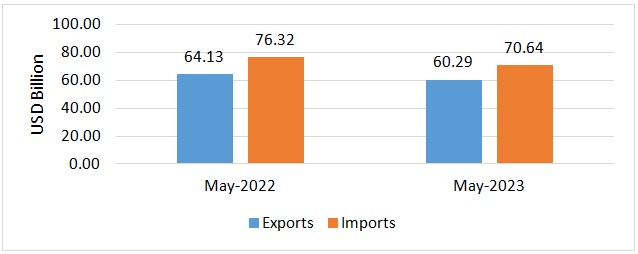
India’s overall exports (Merchandise and Services combined) in April-May 2023 is estimated to exhibit a negative growth of (-) 5.48 per cent over April-May 2022. Overall imports in April-May 2023 is estimated to exhibit a negative growth of (-) 9.63 per cent over April-May 2022.

Table 2: Trade during April-May 2023*


April-May 2023

(USD Billion)

April-May 2022

 (USD Billion)

Merchandise

Exports

69.72

78.70

Imports

106.99

119.18

Services*

Exports

51.14

pib.gov.in
16 Jun, 2023
News Image
Agriculture sector to be supported by setting up of common facilities by cooperatives and start-ups using integrated framework of PM GatiShakti: Sh. Piyush Goyal.
Union Minister of Commerce and Industry, Consumer Affairs, Food & Public Distribution and Textiles, Shri Piyush Goyal said that PM GatiShakti must be effectively leveraged using the Area Development Approach to extend benefits to the nation beyond the infrastructure sector. Shri Goyal chaired a meeting to review the progress of PM GatiShakti with DPIIT and eight concerned ministries in New Delhi last evening. The Minister emphasized upon the participating Ministries/Departments to harness the full potential of the integrated platform to further accelerate India's infrastructure and economic growth.
 
Shri Goyal said that the Agriculture sector can be supported by setting up common facilities on agricultural lands by cooperatives and start-ups using the integrated framework of PM GatiShakti and data from the National Master Plan (NMP). The Minister highlighted that the Area Development Approach under PM GatiShakti can be used for engaging with aspirational districts of NITI Aayog.
 
Besides senior officials from the Department for Promotion of Industry and Internal Trade (DPIIT), the meeting saw representation from M/o Road Transport and Highways, M/o Railways, M/o Ports, Shipping and Waterways, M/o Civil Aviation, M/o Power, M/o Petroleum and Natural Gas, Department of Telecommunication (DoT), M/o New and Renewable Energy, Bhaskaracharya National Institute for Space Applications and Geo-informatics (BISAG-N) and National Industrial Corridor Development Corporation (NICDC).
 

Source: pib.gov.in
16 Jun, 2023
News Image
India and Africa are natural partners with historical and cultural ties: Union Commerce and Industry Minister Shri Piyush Goyal.
Union Minister of Commerce and Industry, Consumer Affairs, Food and Public Distribution and Textiles, Shri Piyush Goyal said that India and Africa are natural partners with historical and cultural ties. While delivering the Keynote Address at the 18th CII-EXIM Bank Conclave on 'India-Africa Growth Partnership' in New Delhi today, the Minister recounted that Mahatma Gandhi first practised principles of Satya and Ahimsa in South Africa and Mr. Nelson Mandela took forward this invaluable legacy. 
 
The Minister mentioned his recent interaction with 15 Ambassadors from the African region which was a step towards strengthening this relationship. He said that the bilateral trade of India with Africa grew by 9.26% in FY 2022-23 reaching almost $100 Billion. Shri Goyal said that the exports and imports were approximately balanced with exports being US$ 51.2 Billion and imports being US$ 46.65 Billion in FY 2022-23. He expressed confidence in achieving the goal of doubling the trade volume to US$ 200 Billion by 2030. The Minister said that the young aspirational population can help achieve this goal.
 
Shri Piyush Goyal said that 27 Least Developed Countries (LDCs) of Africa benefit from the Duty-Free Tariff Preference on non-reciprocal basis already and Free Trade Agreements (FTAs) and Comprehensive Economic Partnership Agreement (CEPA) can be explored with other African countries as well. 
 
The Minister stated that the spirit articulated by the Prime Minister Shri Narendra Modi over the last 9 years of developing together as equal partners guides the India-Africa relationship. Shri Goyal said that this spirit has solidified the foundation of this partnership and established brotherhood. He quoted the Prime Minister and said that 'Africa will be at the top of our priorities. We will continue to intensify and deepen our engagement with Africa. As we have shown, it will be sustained and regular'.
 
Shri Piyush Goyal said that the India-Africa relationship has the potential to help fulfil dreams and aspirations of around 1/3rd of the world’s population. He said that both India and Africa are blessed with demographic dividend and with skill development and education of youth, this partnership can drive the global progress in this century.
 
The Minister highlighted how India can be the voice of the Global South and take the voice of the Global South at multilateral forums. Shri Goyal stressed upon creation of a powerful voice of the Global South to influence the geopolitics of the world ensuring equitable and inclusive growth. Shri Piyush Goyal mentioned that India is a friend in need and friend in deed for Africa. He said that during COVID-19 pandemic, India provided support for her African brothers and sisters in the form of medicines, vaccines and other equipment in the spirit of Vasudhaiva Kutumbakam. 
 
Shri Goyal stressed upon collaboration between India and Africa in the field of renewable energy to make the dream of 'One World, One Grid” come true. He said that India and Africa are uniquely poised to become the leaders in production of renewable energy especially solar energy with interconnected grids through overland and underwater transmission lines. The Minister said that this potential of affordable energy for all throughout the day must be leveraged effectively and praised the participation of more than 20 African countries in the International Solar Alliance (ISA). 
 
The Minister said that India strongly believes that Africa’s rise globally is an absolute necessity in present times and is working together in a fast-track manner to achieve this ambition. He said that India’s Startup Revolution and Digital Public Infrastrcuture like Unified Payment Interface (UPI), CoWIN, One Nation One Ration Card (ONORC), Open Network for Digital Commerce (ONDC) have been helpful in enhancing Ease of Doing Business and ease of living and can be replicated successfully for the benefit of Africa. Shri Goyal also suggested exploring further cooperation in the field of logistics like roadways, railways and ports and a diverse, robust and resilient supply chain between Africa and India. 
 
Shri Goyal said that both India and Africa shared the values of Equality and Liberty. He said that the seed of the Conclave was sown in 2005 which has since blossomed and strengthened the relations between India and Africa. The Minister noted the vital role played by the Conclave in bringing together business leaders and policymakers from India and Africa at one platform for further enhancing the partnership.

Source: pib.gov.in
16 Jun, 2023
News Image
MoFPI Hosts Roundtable with Heads of Foreign Missions to Discuss Global Participation in World Food India-2023.
The Ministry of Food Processing Industries organized a significant roundtable discussion with the Heads of Foreign Missions in India, aiming to encourage overseas participation in the highly anticipated World Food India (WFI) 2023. The event took place at the prestigious Sushma Swaraj Bhawan in New Delhi.
 
The second edition of the esteemed 'World Food India 2023' is scheduled to be held from November 3 to 5, 2023, at Pragati Maidan in New Delhi. This international platform seeks to showcase India's thriving food processing sector while also fostering collaborations and attracting investments from global stakeholders. The event is being organized in conjunction with the International Year of Millets 2023 activities and will focus on promoting millets (Shree Anna), organic produce, and indigenous processed food.
 
The roundtable discussion was co-chaired by Anita Praveen, Secretary of the Ministry of Food Processing Industries, and Shri Prabhat Kumar, Special Secretary of the Ministry of External Affairs. The event saw the attendance of Ambassadors, High Commissioners, Charge d'Affaires, and senior representatives from a diverse range of countries.
 
In total, 47 countries were represented during the interactive session. The discussion involved senior officials from the Ministry of External Affairs, Ministry of Food Processing Industries, Department of Commerce, APEDA, MPEDA, and other Commodity Boards. Additionally, representatives from organizing bodies such as FICCI, Invest India, and EY were also present to participate in the deliberations.
 
During the roundtable, Secretary Praveen and Special Secretary Kumar briefed the representatives on various aspects of the World Food India 2023 event. They highlighted India's unique contribution to global food security, emphasizing its vast resource base and substantial consumer market, which makes it an attractive proposition for overseas stakeholders. The discussion also shed light on the different sub-sectors of food processing, including machinery, technological innovations, sustainability, and more.
 
The participating representatives were informed about the extensive preparations made for the event and the abundant opportunities available for participating countries and business entities. The embassy representatives expressed their appreciation for the event's significance in the current global food scenario and pledged their active participation from their respective countries. They also assured the presence of robust food processing sector contingents from their nations.
 
World Food India 2023 demonstrates a 'Whole of Government Approach,' with various ministries, departments, and government organizations collaborating to pool their strengths and ensure the event's success. Partners include the Department of Commerce, Ministry of Ayush, Ministry of DONER, Ministry of MSME, Commodity Boards, and more.
 
The event will feature industry professionals' meetings, B2B/G meetings, exhibitions, a specially curated food experience arena called the Food Street, and a Reverse Buyer Seller Meet (RBSM), making it an unparalleled value proposition for participating stakeholders.
 

Source: krishijagran.com