17 Aug, 2023

Nepal turns to India amid fears of food shortage in festive season, urges to export more rice, sugar
Nepal's festive season, which occurs between October and November, could be at risk of experiencing elevated prices for rice and sugar if measures to ensure a steady supply are not effectively implemented. The Nepal government has requested India to facilitate the supply of paddy, rice and sugar, a senior official said in Kathmandu on Wednesday. According to the official, Nepal has urged India as a precautionary measure to mitigate any possible food scarcity in the upcoming festive season. The request was made through the Ministry of Foreign Affairs to the Indian authorities last week, Commerce and Supplies Ministry Joint Secretary Ram Chandra Tiwari said. 'Nepal has requested India to provide one million tonnes of paddy, 1,00,000 tonnes of rice, and 50,000 tonnes of sugar,' he said. 'No immediate shortage of rice and sugar in the market: Nepal Though there is no immediate shortage of rice and sugar in the market, there are rumours about its possible scarcity following India's decision to ban the export of non-basmati white rice to the international market. So as a precautionary measure, the Nepal government has asked India to supply these food items, Tiwari said. There are also concerns that traders might resort to hoarding these goods, potentially driving up prices as the festive season approaches, market analysts opine. Nepal's festive season, which occurs between October and November, could be at risk of experiencing elevated prices for rice and sugar if measures to ensure a steady supply are not effectively implemented, they say. India bans export of non-basmati white rice On July 20, the Indian government banned exports of non-basmati white rice to boost domestic supply and keep retail prices under check during the upcoming festive season. Non-basmati white rice constitutes about 25 per cent of total rice exported from the country. Considering the Indian ban on non-basmati rice exports and the current weather phenomenon in Nepal, there may be a food crisis for a short period, say experts. Nepal is heavily dependent on imported food, mostly from India. According to a recent report in The Kathmandu Post newspaper, from April 2021 to March 22, Nepal imported 1.4 million tonnes of rice — 1.38 million tonnes of non-basmati and 19,000 tonnes of basmati rice — from India, the highest import on record. Nepali traders say that immediately after India stopped the export of rice, retail prices jumped by NRs 200 to NRs 250 per 25-kg bag. They say that prices are expected to increase further, particularly during the festive season, report said. Nepal's request for foodgrains came as India is importing tomatoes from the Himalayan nation to arrest the spike in prices following heavy rainfall in key procuring centres in the country.
Source:
indiatvnews.com
|
17 Aug, 2023

First-ever WHO Global Summit on Traditional Medicine to be held in Gandhinagar, Gujarat
Ministry of Ayush and World Health Organisation are organising the two day Traditional Medicine Global Summit, on 17th and 18th August 2023 in Gandhinagar, Gujarat. Secretary, Ministry of Ayush Vaidya Rajesh Kotecha brief the media today at Gandhinagar, Gujrat ahead of the first global summit on traditional medicine. Additional Secretary, Ministry of Health and Family Welfare Shri Lav Agarwal also addressed the media. The Union AYUSH Secretary highlighted that the Global Centre on Traditional Medicines in Jamnagar, Gujarat, established by the WHO, is the first such centre in a developing country. He also informed that the WHO will convene the Traditional Medicine Global Summit, co-hosted by the Ministry of AYUSH, on 17th and 18th August, 2023 in Gandhinagar which will explore the role of traditional, complementary and integrative medicine in addressing pressing health challenges and driving progress in global health and sustainable development. In response to a question on holistic healthcare in Ayush, Vd. Kotecha said that work on traditional medicine systems is ongoing in multiple directions on multiple platforms. He said that Along with mainstream health care, evidence-based research is being done in the field of AYUSH today in dealing with diseases like cancer, TB, communicable diseases and women and child health with scientific approach. Addressing the media persons Vd. Kotecha, stated, “The G20 is a unique opportunity to showcase India's leadership in the field of traditional medicine. In the last 9 years, India has developed eight folds in the field of traditional medicine. By the end of the year, more than 12,500 Ayush-based Health & wellness centers will be functional across the nation, out of which 8,500 are already in place”. During the discussion, Vd. Kotecha shared that the Ayush visa will facilitate global access to Indian traditional medicine systems and will usher in a new era of comprehensive healthcare. One of the summit’s most noteworthy features is the Ayush Exhibition Zone, an attraction not to be missed, he added. It promises to be an immersive experience with innovative and interactive kiosks. During the press briefing, secretary Ayush applauded the collaboration between the Indian government and the WHO in hosting the largest international event on Traditional Medicine. He highlighted the significance of the WHO Global Centre for Traditional Medicine, which was inaugurated in 2022 as the United Nation’s first and largest traditional medicine outpost in any developing country. Health ministers from 30 countries will attend this two-day event. It is expected to be one of the largest gatherings of its kind, bringing together participants from over 90 countries, distinguished members of academia, government representatives and significant players from the traditional medicine sector. Shri Lav Agarwal provided an overview of India’s healthcare sector and its progress, as well as the challenges it faces and its current priorities. With India holding the current G20 presidency, he highlighted the nation’s strengths in healthcare and urged for efforts to be focused on maximizing its contribution to the global healthcare sector. Shri Lav Agarwal praised India’s contribution to the world’s well-being. He brought to attention the many Yoga Centres that have come up in the far-flung regions of the globe, enhancing their healthcare. He added that India’s approach is holistic healthcare through modern and Ayush medicine.
Source:
pib.gov.in
|
17 Aug, 2023

Huge progress in India-UK talks on free trade pact; looking to resolve issues during meetings this month: Official.
There is a 'huge' progress in the talks between India and the UK on the proposed Free Trade Agreement (FTA) and New Delhi is looking to resolve the pending issues during high level meetings scheduled this month between the two countries, a top official said on Monday. The 12th round of talks between the countries are in progress here. Commerce Secretary Sunil Barthwal said the 11th round of talks in London was 'very intense' and many issues got closed. Out of the total 26 chapters in the proposed FTA, 19 have been closed. Investment is being negotiated as a separate agreement (bilateral investment treaty) between India and the UK. 'Now, there are only few issues left. The UK team is coming to India during the Trade and Investment Working Group (TIWG) meeting (in Jaipur) and we are hoping that we would be closing those remaining issues. 'So, our target is that we close the issues with the UK when the UK team visit us in India and we are very hopeful that the issues will be sorted out,' Barthwal told reporters here. As talks are moving at a healthy pace, the negotiations for the agreement could be concluded soon. 'I think there is a good possibility of the UK FTA moving forward... there are a lot of steps before FTA is signed,' he said, adding 'there is a huge progress on the FTA'. One section of the UK team is already here in the national capital and the remaining officials are coming from August 16. The UK trade minister and DG Trade, counterpart of India's commerce secretary, will be here this month for the talks and TIWG meeting. The minister-level meeting is expected on August 21 here. 'Lot of visits are happening that is why we are saying that we are very keen to close the remaining chapters during this visit,' Barthwal said. The main issues which could come up for discussions in this round include investment treaty, reduction of duties on auto and whiskey, rules of origin, intellectual property rights and matters pertaining to services. The Indian industry is demanding greater access for its skilled professionals from sectors like IT, and healthcare in the UK market, besides market access for several goods at nil customs duties. On the other hand, the UK is seeking a significant cut in import duties on goods such as scotch whiskey, automobiles, lamb meat, and certain confectionary items. Britain is also looking for more opportunities for UK services into Indian markets in segments such as telecommunications, legal and financial services like banking. The bilateral trade between the countries increased to USD 20.36 billion in 2022-23 from USD 17.5 billion in 2021-22.
Source:
economictimes.indiatimes.com
|
17 Aug, 2023

India-Canada trade negotiations: CEPA Talks 2.0 reinforce importance of aiming for interim agreements.
The fact that India-Canada trade and economic relations have stagnated at such low levels seems even more surprising since the solution to reverse status quo was provided by the businesses of the two countries as far back as in 2008. When India and Canada began negotiating a Comprehensive Economic Partnership Agreement (CEPA) in 2010, the primary reason for doing so was the large untapped markets waiting to be exploited by their businesses. India-Canada trade links were at unacceptably low levels despite the large presence of the Indian diaspora in Canada, the third-largest in the developed world after the US and the UK. Since the mid-2000s, India has had a minor presence in Canada’s market. Imports from India have been less than1% of Canada’s total imports, although this share has been increasing in recent years and was just over 1% in 2022. Similarly, Canada’s share in India’s total imports exceeded the 1% threshold only in 2015-16. Clearly, the businesses in the two countries have made little efforts to galvanise India-Canada trade relations. A recent report by the Canada-India Business Council summed up the situation from the Canadian perspective quite well. The report argued that Canadian exporters and investors have not taken full advantage of the wealth of opportunities open to them since for many, India is at best an afterthought. The fact that India-Canada trade and economic relations have stagnated at such low levels seems even more surprising since the solution to reverse status quo was provided by the businesses of the two countries as far back as in 2008. The India-Canada CEO Round Table had recommended that India and Canada should formalise the CEPA that would benefit the two countries through market opening initiatives, including elimination of tariffs on a substantially large share of the products traded between the two countries, liberalising services trade, and inclusion of other areas of economic cooperation. This was the most effective justification for the CEPA, based on which the two governments initiated the process of negotiations for opening their respective markets for enhancing the levels of trade and investment. It must be pointed out that the CEPA negotiations followed the Canadian approach towards engaging in bilateral free trade agreements, which has been to negotiate three separate but linked agreements, namely, a comprehensive market opening agreement covering goods, services, and investment, coupled with parallel agreements on labour cooperation and on environmental standards. Interestingly, Canada insisted on including the agreements on labour cooperation and environment standards despite being aware that “while Canada will pursue adherence to international standards for labour and environment protection, India has—in the past—resisted the inclusion of labour and environmental measures in international trade agreements”. This position of the Canadian government was revealed to Standing Committee on International Trade of the Canadian House of Commons, which reviewed the progress of the CEPA negotiations between 2011 and 2013. Thus, given this stance of the Canadian government, it appeared from the initial phases of the CEPA negotiations that an agreement encompassing all the areas was not easy to achieve. Even the businesses that had provided the initial impetus for the two countries to conclude the CEPA seemed uncertain about the nature of the final agreement. The Canada-India Business Council opined that it was “to be expected that a possible Canada-India CEPA would not be as comprehensive as a possible trade agreement between Canada and the European Union, for instance”. On the other hand, the Canadian Chamber of Commerce argued that a Canada-India CEPA should be “a comprehensive, balanced, and high-quality agreement that will ensure long-term, real market access for Canadian exporters of goods and services” Differences in negotiating approaches put the CEPA negotiations on the backburner in 2017, and it remains so till date. After a four-year hiatus, the India and Canada agreed to relaunch the CEPA negotiations, with their trade ministers also agreeing to consider an Interim Agreement or Early Progress Trade Agreement (EPTA), that could bring early commercial gains. The Interim Agreement is expected to include high level commitments in goods, services, rules of origin, sanitary and phytosanitary measures, technical barriers to trade, and dispute settlement. India and Canada decided to strengthen their trade and commercial ties by focusing on agro products, chemicals, footwear, textiles, automobiles, energy, electronics, minerals and metals, urban development, information technology and tourism. There were several interesting facets to this relaunch of CEPA negotiations, and more importantly, through the decision to consider the Interim Agreement or the EPTA. First, the EPTA seems to be modelled on the India-Australia Economic Cooperation and Trade Agreement (ECTA), adopted in 2022 as the first step towards an eventual CEPA between the two countries. Secondly, like the ECTA, the EPTA is a more conventional FTA that includes market access for goods and services, and complementary rules packaged together to ensure immediate gains. And finally, while relaunching the negotiations, the two countries have carefully avoided any references to the contentious issues like labour and environmental standards. However, the agreement to pursue the EPTA by putting the CEPA on the backburner does not imply that the pathway to the interim agreement will be smooth. This is because market access negotiations involving a few sectors that the trade ministers have been identified as the drivers of the bilateral trade ties may not be easy. For instance, Canada has significant export interest in automobiles, but India’s domestic industry has been reluctant to allow deep cuts in tariffs. Pulses is another area in which Canada would seek assured levels market access from India. India would be looking for greater access for its generic pharmaceutical industry and textiles and clothing. India’s recent experiences of negotiating bilateral trade agreements with Australia and now with Canada has some important lessons for its future engagements with advanced countries. It seems prudent to forge interim agreements by identifying the areas in which agreements can easily be reached; the contentious issues should not prevent securing early gains from the trade deals.
Source:
financialexpress.com
|
17 Aug, 2023

Telangana among top five states in exporting millets.
In the International Year of Millets 2023, Telangana is riding high by occupying fifth place in the country in millet exports to other nations. Though at a very limited scale, the state exported 1,680 metric tonnes of millets in the year 2022-23 with orders worth Rs 29 crore. Gujarat tops the charts with 78,106 MTs of exports, followed by Maharashtra (50,486 MTs), Bihar (19,917 MTs) and West Bengal at 12,587 MTs of exports. India exported a total of 1,69,049 MTs of millets. In Telangana, districts such as Medak and Rangareddy have large potential. While some states have launched their ‘millet missions’, Telangana introduced millet-based meals in the food distribution programme for underprivileged students and pregnant mothers. This programme was acknowledged by Niti Aayog as one of the best examples of prompting millet-based foods for health benefits, an official said. The Agricultural and Processed Food Products Export Development Authority (APEDA) created a millet-specific web portal with information about millet, their health benefits, production and export statistics and a millet exporter’s directory. APEDA has also organised a comprehensive global marketing campaign highlighting India’s potential and e-catalogues of 30 importing countries and 21 millet-producing states have been released as a result. A virtual trade fair for millets has been developed and made available to exporters and importers from around the world, allowing them to interact and negotiate business deals on a single platform. APEDA has also organised participation in international trade fairs such as BIOFACH in Germany, Gulfood in Dubai, Natural Products Expo West in the United States, International Food and Drink and BSM in the United Kingdom, SIAL Food in Canada, and Seoul Food and Hotel in South Korea.
Source:
timesofindia.indiatimes.com
|
17 Aug, 2023

India looking at FTAs for strategic considerations also, says Commerce Secretary.
India is looking at Free Trade Agreements (FTAs) not only from the trade point of view but also keeping in mind the country's strategic needs, especially with regard to the smooth supply of critical minerals, a top government official said on Monday. Commerce Secretary Sunil Barthwal said that India is now looking at FTAs from the point of view of what is the country's strategic needs in addition to trade. For instance, batteries in electric vehicles require critical minerals. India is in talks with Australia for its smooth supplies. 'So, in addition to trade, now, we are looking at FTAs from the point of view of our strategic considerations. So, that is the fresh approach that we are taking in our FTAs,' Barthwal told reporters. Normally in a trade agreement, two or more countries either significantly reduce or eliminate customs duties on a maximum number of goods traded between them. They Norms are also eased for facilitating trade in services and boost investments. Securing a smooth supply of the critical minerals will help India in its energy transition. Lithium, nickel, cobalt, manganese and graphite are among the key minerals used in batteries.
Source:
economictimes.indiatimes.com
|
17 Aug, 2023

India-Bangladesh Friendship Bridge Maitri Setu To Enhance Trade Relations, Inauguration Set For September 01.
Agartala, August 16, 2023: In a significant development, the much-awaited India-Bangladesh Friendship Bridge, fondly known as 'Maitri Setu,' is poised to unlock new avenues of trade and communication as it prepares for its grand inauguration on September 1. A pivotal meeting convened on Wednesday at 11:30 am, in the conference hall of Sabroom Nagar Panchayat, marked a crucial step forward in this historic endeavor. Chaired by Saju Waheed A, the District Magistrate of the southern district, the meeting witnessed the convergence of key stakeholders including Sub-Divisional Magistrate Bidhanchandra Roy, Commandant Raspal Singh of BSF No. 96 Battalion, Land Ports Authority of India Manager Debasish Nandi, Customs Superintendent Pranesh Dhar, and Sabroom Nagar Panchayat Chairperson Rama Poddar Dey, alongside other luminaries from the Sub-Divisional Administration of Sabroom. During the half-hour deliberation, an array of pertinent issues took center stage. Notably, discussions revolved around addressing the drainage challenges experienced by flood-prone areas during monsoon due to the integrated check post, the installation of a drinking water pump house, and reinforcement of the electrical infrastructure within the confines of the integrated check post. Of utmost significance, District Magistrate Saju Waheed A underscored the imminent inauguration of the long-awaited 'Maitri Setu,' poised to become the gateway to South Asia. The bridge’s ceremonial opening on the 1st of the upcoming month marks a historic milestone, expected to foster robust trade and connectivity between the two nations. Highlighting defense considerations, the vicinity adjacent to the integrated check post will witness deployment of the valiant jawans from the 126 Battalion of the Border Security Force (BSF), along with the presence of soldiers from the 96th Battalion of the Border Guard of Bangladesh (BGB). District Magistrate Saju Waheed A, a key proponent of this monumental development, spoke candidly to the media, sharing insights into the day’s proceedings. The anticipated inauguration of the 'Maitri Setu' has generated palpable excitement within the public sphere, heralding a new era of cross-border cooperation and opportunity It is worthy to mention here that the ‘Maitri Setu’ is 1.9 kilometres long bridge connecting Sabroom (India) and Chittagong Port (Bangladesh) which is about 80 KMs away. Prime Minister Narendra Modi inaugurated the ‘Maitri Setu’ between India and Bangladesh, with his counterpart Bangladesh’s PM Sheikh Hasina in March, 2021.
Source:
northeasttoday.in
|
17 Aug, 2023

USDA Lowers Global Rice Trade Forecasts in 2023, 2024.
The United States Department of Agriculture (USDA) announced August 15 it had lowered its global rice trade forecasts for 2023 and 2024 following India’s ban on exports of non-basmati white rice in July. The USDA reduced its forecast for 2023 by 1.9 million tons to 53.8 million total tons, and by 3.4 million tons to 52.9 million tons for 2024. The reduction of rice exports from India in 2024 is expected to be partially offset by increased export forecasts for Russia, Pakistan, Vietnam and Brazil. Meanwhile, import forecasts fell for several major importers based in Asia and Sub-Saharan Africa in both 2023 and 2024. U.S. rice production is projected to increase by 27% during 2023 and 2024, while American rice exports will grow by 25% during the same period. 'For both years, the global export forecast is sharply lowered due to India’s July 20-announced immediate ban on sales of non-basmati and non-parboiled milled rice to ensure domestic availability of non-basmati rice and prevent higher domestic prices,' the USDA said in a report. India accounts for slightly more than 40% of global rice exports and ships rice to around 140 countries.
Source:
supplychainbrain.com
|
16 Aug, 2023
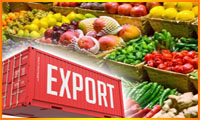
Agricultural exports registered robust growth: Fruits and Vegetables exports increase by 18.94%, Oil Seeds by 32.83%, Oil Meals by 34.24%, Rice by 5.38% in July 2023 over July 2022
- India’s overall exports (Merchandise and Services combined) in July 2023* is estimated to be USD 59.43 Billion, exhibiting a negative growth of (-) 5.06 per cent over July 2022. Overall imports in July 2023* is estimated to be USD 67.77 Billion, exhibiting a negative growth of (-) 12.92 per cent over July 2022.
Table 1: Trade during July 2023* | | | July 2023 (USD Billion) | July 2022 (USD Billion) | | Merchandise | Exports | 32.25 | 38.34 | | Imports | 52.92 | 63.77 | | Services* | Exports | 27.17 | 24.26 | | Imports | 14.85 | 14.06 | | Overall Trade (Merchandise +Services) * | Exports | 59.43 | 62.59 | | Imports | 67.77 | 77.83 | | Trade Balance | -8.35 | -15.24 | * Note: The latest data for services sector released by RBI is for June 2023. The data for July 2023 is an estimation, which will be revised based on RBI’s subsequent release. (ii) Data for April-July 2022 has been revised on pro-rata basis using quarterly balance of payments data. Fig 1: Overall Trade during July 2023* 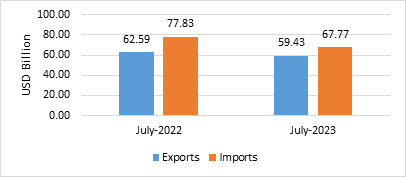 - India’s overall exports (Merchandise and Services combined) in April-July 2023 is estimated to exhibit a negative growth of (-) 5.98 per cent over April-July 2022. Overall imports in April-July 2023 is estimated to exhibit a negative growth of (-) 11.09 per cent over April-July 2022.
Table 2: Trade during April-July 2023* | | | April-July 2023 (USD Billion) | April-July 2022 (USD Billion) | | Merchandise | Exports | 136.22 | 159.32 | | Imports | 213.20 | 247.31 | |
pib.gov.in
|
16 Aug, 2023

Fast track action to remove non-tariff barriers key to realise trillion-dollar merchandise export goal: GTRI report.
India needs to act in a fast-track manner for removal of non-trade barriers (NTBs), being faced by domestic exporters in different countries like the US, China and Japan, to achieve one trillion dollar outbound shipment target for goods by 2030, a report by think-tank GTRI said on Tuesday. The Global Trade Research Initiative (GTRI) has suggested a two-pronged strategy to mitigate the influence of NTBs on exports. It asked for upgrading domestic systems, in cases where Indian products are rejected due to quality issues; and retaliating if unreasonable standards or rules continue to obstruct exports from New Delhi. 'Many of India's exports suffer due to time taking prior registration requirements and unreasonable domestic standards/rules in many countries. India must talk to partner countries for reasonable solutions,' GTRI Co-founder Ajay Srivastava said. He added that many of India's food and agriculture products face problems due to higher pesticide levels, presence of pests and contaminations due to foot and mouth disease. 'India must take each issue and address it in the shortest possible time,' Srivastava said adding 'India's exports are far below potential as they face NTBs in the EU (European Union), USA, China, Japan, Korea and many other countries'. Key Indian exports that routinely face high barriers include -- Chillies, Tea, Basmati Rice, Milk, Poultry, Bovine Meat, Fish, Chemicals Products to EU; Sesame Seed, Black Tiger Shrimps, Medicines, Apparels to Japan; Food, Meat, Fish, Dairy, Industrial Products to China; Shrimps to the US; and Bovine Meat to South Korea. According to the report, the other products which face these barriers include Ceramic Tiles in Egypt; Chili in Mexico; Medicines in Argentina; Microbiological Regents in Saudi Arabia; Electrical, Medical Devices, Household Appliances in Brazil; Veterinary Pharmaceuticals, Feed Additives, Machinery in Russia. Most non-tariff measures (NTMs) are domestic rules created by countries with an aim to protect human, animal or plant health and environment. NTM may be technical measures like regulations, standards, testing, certification, pre-shipment inspection or non-technical measures like quotas, import licensing, subsidies, government procurement restrictions. When NTMs become arbitrary, beyond scientific justification, they create hurdles for trade and are called NTBs (non-tariff barriers). 'The hindrance posed by NTBs on India's export performance is a critical challenge. A time frame must be decided to resolve important NTBs,' it said. About these barriers, the report said that there are three sub-categories that are reducing pesticide levels in food products; presence of pests like food and mouth disease; and higher inspection due to suspect product quality. India's exports of basmati rice, chillies, tea and many other agriculture products face difficulty in foreign markets due to higher use of pesticide and fungicides. The traces pesticides leave in treated products are called 'residues' and a maximum residue level (MRL) is the highest level of a pesticide residue that is legally tolerated in food or feed. Citing certain examples, the report said the EU has set MRL for tricyclazole, a fungicide in rice, to 0.01 mg per kg as against the ten times higher limit earlier. Now the EU has proposed to raise the limit to 0.09 as the current level is 'unreasonable and hampers' trade. Similarly, the EU has set MRL for aflatoxins B1 level in chilies and other spices at 5 to 10 ppb (parts per billion). The US limit is a higher 20 ppb for all spices. The European Union has set the level for Anthraquinone for tea at 0.02 mg/Kg. No tea grower in India uses anthraquinone as a pesticide. Tea leaves get it from the dust in the atmosphere. Japan stopped importing sesame seeds from India from 1992-93 due to pesticides/DDT traces, it said. Export of milk and poultry, bovine meat products to the EU and bovine meat to China and South Korea is difficult due to the prevalence of foot and mouth disease (FMD) in India. 'India needs to invest in creating FMD free zones to export freely,' it suggested. It added that each consignment of Black Tiger Shrimp and Vannamei exported from India to Japan undergoes 100 per cent inspection by Japanese Authorities. This is done to rule out the presence of an antibiotic residue called Nitrofuran metabiolite AOZ. There has been no detection of AOZ in Black Tiger shrimp for the last three years. Likewise, the EU has increased the sampling frequency from 10 per cent to 50 per cent on marine products exported from India due to frequent detection of prohibited antibiotics. Mexico has also suspended import of Indian dry chilies in May, 2017 after live pest (Trogoderma) was detected in two containers. Further regarding registration systems in different countries, the report said that registration, in most cases, requires physical submission of documents and payment of exorbitant fees. 'Big pharma firms abuse patent laws as they recycle and repurpose old drugs and patent them as new, thereby encouraging ever-greening of patents. Three of every four drugs associated with new patents are not new, but existing drugs. This delays the launch of affordable generic drugs,' it said.
Source:
economictimes.indiatimes.com
|
|