28 Jun, 2023

Government to release Tur from national buffer till imported stocks arrive in Indian market; Tur to be disposed through online auction among eligible millers.
The Government has decided to release Tur from the national buffer in a calibrated and targeted manner till imported stocks arrive in the Indian market. The Department of Consumer Affairs, Ministry of Consumer Affairs, Food & Public Distribution has directed National Agricultural Cooperative Marketing Federation (NAFED) and National Cooperative Consumers Federation (NCCF) to dispose of Tur through online auction among eligible millers to augment the available stocks for milling into Tur Dal for the consumers. The quantities being auctioned and the frequency will be calibrated on the basis of the assessed impact of the disposal on the availability of Tur to consumers at affordable prices. It may be recalled that the Government had, on 2nd June, 2023, imposed stock limits on Tur and Urad by invoking the Essential Commodities Act, 1955 in order to prevent hoarding and unscrupulous speculation and also to improve affordability to the consumers. Under this order, stock limits have been prescribed for Tur and Urad until 31st October 2023 for all states and UTs. Stock limits applicable to each of the pulses individually are 200 MT for wholesalers; 5 MT for retailers; 5 MT at each retail outlet and 200 MT at depot for big chain retailers; last 3 months of production or 25% of annual installed capacity, whichever is higher, for the millers. The order has also made it mandatory for these entities to declare the stock position on the portal (https://fcainfoweb.nic.in/psp) of the Department. The implementation of stock limit order and status of stock disclosure on the portal are continuously monitored by the Department of Consumers Affairs and the State Governments. In this regard, data on stocks held by various entities in warehouses of Central Warehousing Corporation (CWC) and State Warehousing Corporations (SWCs), stocks pledged by market players with banks etc. have been crosschecked against the quantities declared on the stock disclosure portal. The State Governments are continuously monitoring the prices in their respective States and are verifying the stock positions of stock-holding entities in order to take strict action on those who violated the stock limits order.
Source:
pib.gov.in
|
28 Jun, 2023

20 pc retaliatory duty removal on American apple imports to have 'zero' impact on Indian farmers: official.
The decision to remove 20 per cent retaliatory customs duty on imported American apples will have a 'zero' impact on Indian farmers as the government has sufficient policy space to support growers if there is any implication of the move, a senior government official said on Monday. Additional Secretary in the Department of Commerce Peeyush Kumar said that India is not giving anything 'extra' by removing this duty and it was not that 'we have opened a floodgate' for American apples. In fact, it is a win-win deal for India as it restores market access for domestic steel and aluminium products in the American market, which was impacted due to the imposition of high duties by the US in 2018. The decision to remove these additional duties was part of an agreement reached between India and the US, during the recent visit of Prime Minister Narendra Modi to Washington and New York. India and the US have also agreed to terminate six trade disputes at the World Trade Organisation (WTO). These remarks assume significance as Congress leader Jairam Ramesh in a tweet alleged that Prime Minister Narendra Modi 'wants Apple to invest (not investigate) in India. But does he even care for the apple growers of Himachal Pradesh? He has avenged his election loss in Himachal by slashing import duties on American apples. Never before has India seen a more petty PM!' India will remove these duties on eight US products including chickpeas, lentils and apples, which were imposed in 2019 in response to America's measure to increase tariffs on certain steel and aluminium products. India imposed retaliatory duties on 28 US products. America imposed an import duty of 25 per cent on steel products and 10 per cent on certain aluminium products on grounds of national security. 'There would be zero impact on Indian farmers due to the duty removal' because the import duty on apples still is at 50 per cent, Kumar told PTI. Now India is also getting greater market access for its steel and aluminium products in the US, 'so it was not that, we are giving something extra,' he said. Import of apples from the US decreased sharply from USD 145 million (127,908 tonnes) in 2018-19 to only USD 5.27 million (4,486 tonnes) in 2022-23. It indicates that the market share of the US apples was taken by other countries due to imposition of additional retaliatory duty on American apples, as the imports from countries other than the US increased from USD 160 million in 2018-19 to USD 290 million in 2022-23. The US's import share in the import market segment was taken by countries like Turkey, Chile, New Zealand and Italy. After the removal of additional duties on the US apples -- as a part of the resolution of a WTO dispute which would result in the restoration of market access for Indian steel and aluminum exports to the US -- would compete on level-playing field with other countries, while it does not result any additional negative impact on domestic apple producers. Earlier the commerce ministry in May imposed MIP (minimum import price) of Rs 50 per kg on apples, except for Bhutan. This MIP will be applicable on apples from the US as well as other countries (excluding Bhutan), which would prevent flooding and protect domestic growers from predatory pricing and poor-quality/ cheap imports. 'While Indian apple growers will continue to gain from the MFN duty and the MIP that was imposed for all countries except Bhutan, removal of additional duties for the US will result in competition in imports in the premium market segment ensuring better quality at better prices for consumers,' another official said. There is no reduction on MFN (most favoured nation) duty on apples, which is still applicable on all imported apples including on the US at 50 per cent.
Source:
economictimes.indiatimes.com
|
27 Jun, 2023

India, Australia may conclude talks for comprehensive trade deal by Dec.
India and Australia plan to conclude negotiations for a comprehensive trade pact by December, a year after implementing the interim Economic Cooperation and Trade Agreement (ECTA), according to people aware of the matter. When the ECTA was signed last year, it was decided that the larger idea would be to use the foundation of the interim deal to resume negotiations on the more ambitious trade deal or the Comprehensive Economic Cooperation Agreement (CECA). The new deal will include discussions on deeper market access and outcomes in five areas, including digital trade, goods, services, rules of origin, and government procurement and cooperation. That apart, a broader trade agreement between India and Australia may include 15 new areas, such as competition policy for small businesses, gender, innovation, agri-tech, critical minerals, sports, and are currently under discussion. Both sides have had three rounds of negotiations. The fourth round is scheduled for next month. The deal with Australia is crucial since it is among the first developed nations to finalise a trade pact with India. Under the ECTA, Australia has agreed to eliminate Customs duty immediately on 98.3 per cent of traded goods and on 100 per cent tariff lines over a period of five years. India, on the other hand, will do away with Customs duties on 40 per cent of products immediately and on 70.3 per cent of tariff lines over a period of 10 years. During FY23, Australia was India’s 13th largest trading partner, with bilateral merchandise trade at $25.96 billion. India exported goods worth $6.95 billion, while imported goods worth $19.01 billion during the same time period.
Source:
business-standard.com
|
27 Jun, 2023

India, Egypt to push trade to $12 billion in next five years.
India and Egypt plan to push bilateral trade to $12 billion within the next five years. This was discussed during a meeting between Prime Minister Narendra Modi and the India unit of the Egyptian Cabinet led by its Prime Minister Mostafa Madbouly in Cairo on Saturday, officials said. The volume of trade between the two countries amounts to around $7 billion currently. Indian foreign direct investment (FDI) in Egypt is around $4 billion. In the past six months alone, Indian companies have invested around $170 million in the African Arab country. Egypt is hoping that India increases its presence in the Suez Canal Economic Zone. During Saturday's meeting, Modi had mentioned that India is an important source of foreign investments to Egypt, and that the two countries have been increasing cooperation in the field of renewable energy, which reflects their joint commitment to protect environment. Egypt is an important partner to India, Modi had stressed, affirming that cooperation between the two countries have increased despite Covid and global tensions. In the meeting, Madbouli said Egypt looks forward to consolidating the strategic relations with India with regard to exchanging strategic goods, especially with regard to making India into one of the main sources of wheat exports to Egypt. Modi returned to India in the early hours of Monday. India's top exported items to Egypt during April-December 2022 were meat (13.5%), ferro-alloys (5.2%), rice (2.6%) and flat rolled products of iron (2.2%). India's top imported items from Egypt during the same period were petroleum oil (39%), petroleum gas (19.3 %), chemical fertilizers (12.1%), ammonia (6.6%) and phosphoric acid (4.7%), according to a factsheet of the Indian Embassy in Cairo. Over 450 Indian companies are registered in Egypt, of which around 50 are active in various sectors. Major Indian investments in Egypt include TCI Sanmar (with a value of $1.5 billion), Alexandria Carbon Black, Kirloskar, Dabur India, Flex P Films, SCIB Paints, Godrej, Mahindra, and Monginis. Indian companies are present in a range of sectors including apparel, agriculture, chemicals, energy, automobiles, and retail.
Source:
economictimes.indiatimes.com
|
27 Jun, 2023

Healthy numbers. Horticulture production in 2022-23 estimated at record 351 million tonnes.
India’s horticulture output is likely to have reached a record 350.87 million tonnes (mt) in the current crop year (July 2022-June 2023) as production of fruits, vegetables, spices and plantation crops increased significantly. However, among the key essential items, onion and tomato production has been estimated a tad lower but potato output has been pegged higher. The output of all the horticulture products was 347.18 mt in 2021-22. Releasing the first advance estimates of area and production for 2022-23 and final estimates of 2021-22, Union Agriculture Ministry on Monday said data have been compiled on the basis of information received from States and other government agencies. Agriculture Minister Narendra Singh Tomar credited the hard work of farmers and expertise of agriculture scientists as well as the Centre’s policies for the record production. According to data from the Agriculture Ministry, the area under horticulture has been rising and reached 28.28 million hectares (mh) in 2022-23 from 28.04 mh last year. Upward revision Experts said the gap is marginal in the first estimate compared with last year’s final estimate and there could be an upward revision in production in subsequent updates. Onion production is estimated to be 31.1 mt this year, down from 31.69 mt in 2021-22, while tomato production is likely to be 20.62 mt against 20.69 mt. Potato output is expected to be higher at 59.74 mt compared with 56.18 mt last year. Total production of vegetables has been pegged at 212.53 mt compared with 209.14 mt. Fruits production is seen at 107.75 mt this year as against 107.51 mt in 2021-22.
Source:
thehindubusinessline.com
|
27 Jun, 2023

South Africa's reliance on rice imports.
South Africa relies heavily on imports for its rice requirements. Estimates indicate that South Africa imports 90% of its rice requirements. This exposes consumers to high prices in the event of global supply shocks, exchange rate fluctuations and outright export bans from major rice-producing countries as witnessed in 2020 at the height of the Covid-19 pandemic. In recent months there has been an increase in global rice prices influenced by limited global rice supplies. This coupled with the weak rand is likely to result in higher rice prices for the South African consumer. Figure 1 below, shows the evolution of domestic rice prices between January 2008 to April 2023. As shown in Figure 1 below, domestic rice prices were fairly constant until 2020 at the height of the Covid-19 pandemic. Prices have ever since moderated but still remain higher than the pre-pandemic levels. The rice price per kilogramme (kg) was R27.47 in April 2023. As shown in Figure 2 below, the rice price per kg in April 2023 was 1.2%, 5.6% and 13.7% higher compared to a month ago, six months ago and a year ago, respectively. According to data from TradeMap ITC, South Africa imported approximately 1.1 million tonnes of rice to the value of R7.8 billion in 2022. Figure 2 below, shows the trends in South Africa’s rice imports by volume and by value from 2003 to 2022. During this period, South Africa’s rice imports by volume increased at a compounded annual growth rate of 1.3% compared to a CAGR of 10.3% by value. Figure 4 below, shows that South Africa’s leading sources of rice imports in 2022 were Thailand (76.5%), India (19.1%), Pakistan (1.8%), Viet Nam, (0.8%) and China (0.5%), amongst others. Rice is a summer crop mostly grown in paddy conditions. Small quantities of rice are currently grown in South Africa. Data from the United States Department of Agriculture’s Rice Explorer shows that rice production in South Africa is mostly in KwaZulu-Natal (43%), the Free State (34%) and Limpopo (19%). The long-held view has been that rice is a water-intensive crop and it cannot be grown commercially because of water scarcity in South Africa. However, there is scientific evidence that suggests that there are dryland rice varieties that give good yields that can be grown commercially in South Africa. Here lies the potential for upscaling the existing and new rice farmers through technical support, finance and the development of a domestic rice value chain. This has the potential to create employment along the rice value chain from the farm to the retail. Importantly, this import substitution strategy is likely to reduce unemployment, poverty and inequality. In addition, consumers are likely to be insulated from the fluctuations in global trade policies and consequently the resultant high prices.
Source:
bizcommunity.com
|
27 Jun, 2023

Demand for nutraceutical products drives growth in Indian market, projected to reach $18 bn by 2025.
A workshop on natural biopolymers has observed that the demand for nutraceutical products has increased in recent years resulting in a remarkable sector growth with a CAGR of 20 per cent over the past three years. This trend is driven by increasing health awareness among the public and a growing emphasis on preventive healthcare. Projections indicate that the nutraceutical market in India will expand from an estimated $4 billion to an impressive $18 billion by the end of 2025, according to experts. The ICAR-Central Marine Fisheries Research Institute organised the workshop under the Scientific Social Responsibility policy. Experts also viewed the increasing demand for nutraceutical products as an indication of the need to utilise untapped natural resources. CMFRI Director A Gopalakrishnan stressed the urgent need to explore marine organisms to unearth novel bioactive compounds capable of addressing unmet medical needs and propelling the frontiers of healthcare. Medicinal uses CMFRI’s nutraceutical products from the seaweeds to treat various lifestyle diseases such as diabetes, obesity, arthritis, hypertension, thyroid, etc. have received an overwhelming response from the public. He said that the institute will continue to explore the medicinal prospects of such marine organisms, adding that efforts are required to tap the immense potential of natural resources like marine organisms for the development of innovative pharmaceutical products. The workshop aimed to share the latest information and technologies related to the isolation, characterisation and development of natural biopolymers with pharmaceutical applications, said Kajal Chakraborty, Principal Scientist and workshop coordinator. The development of value-added products from marine organisms such as seaweeds will provide health benefits to consumers and create opportunities for the downstream value chain. Natural biopolymers such as proteins, polysaccharides and nucleic acids hold great promise in the field of medicine, he added.
Source:
thehindubusinessline.com
|
27 Jun, 2023

The removal of additional retaliatory duties for import of US apples will not result in any negative impact on domestic apple producers.
With the decision of resolution of six outstanding World Trade Organisation (WTO) disputes between US and India through mutually agreed solutions as jointly communicated during the official state visit of the Prime Minister to the USA, India will remove additional duties on eight US products, including apples, leading to restoration of market access for Indian steel and aluminum exports to the US. The decision will not result in any negative impact on domestic apple producers and will result in competition in premium market segment ensuring better quality at better prices for consumers. After removal of this duty, the apples from the US would compete on level playing field with other countries. The decision will ensure that only premium quality apples could be imported for which there exists a specific market segment and specific demand. An additional 20% duty was imposed on US apples in 2019 in response to USA's measure to increase tariffs on certain steel and aluminum products. There is no reduction on Most Favoured Nation (MFN) duty on apples which is still applicable on all imported apples including on USA at 50%. The import of apples from the world has been stable in the range of US$ 239 – 305 million (except in 2021-22 when it was US$ 385 million) in the last five financial years since application of these additional duties on US apples. The import of apples from USA has decreased from US$ 145 million (127,908 Ton) in FY 2018-19 to only US$ 5.27 million (4,486 Ton) in FY 2022-23. The market share of the US apples was taken by other countries due to imposition of additional retaliatory duty on US apples. This is reflected as the import of apples from countries other than the US increased from US$ 160 million in FY 2018-19 to US$ 290 million in FY 2022-23. Turkey, Italy, Chile, Iran and New Zealand are other top exporters to India of apples which took the market share of the US. Further on 8 May 2023, DGFT vide notification 5/ 2023 made amendment in import policy for Apples under ITC (HS) 08081000 by applying MIP (Minimum Import Price) of Rs 50 per Kg for all countries except Bhutan. Therefore, this MIP will also be applicable on apples from US as well as other countries (excluding Bhutan), thus preventing any flooding and protecting domestic growers from predatory pricing. After application of additional duty on US apples, its share in premium market segment was taken by countries like Turkey, Brazil, New Zealand, Italy, etc. as mentioned above. Data pertaining to apple import is given below: 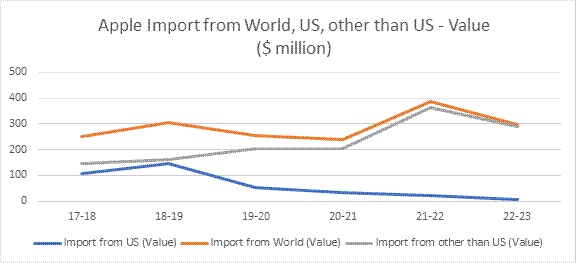 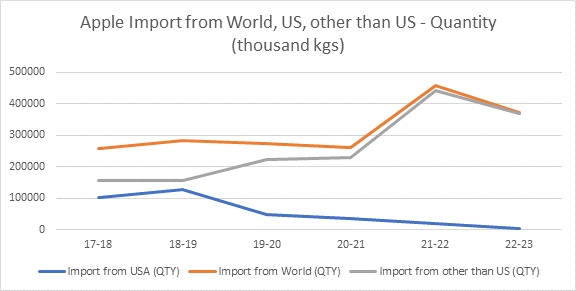 | FY | Import from US (Value) | Import from USA (QTY) | Import from World (Value) | Import from World (QTY) | Import from other than US (QTY) | Import from other than US (Value) | MFN Duty (BCD+AIDC - as applicable) | | 22-23 | 5.27 | 4,486.48 | 295.94 | 373505.70 | 3,69,019.22 | 290.67 | 50 | | 21-22 | 21.82 | 18,396.02 | 385.10 | 459251.84 | 4,40,855.82 | 363.28 | 50 | | 20-21 | 34.60 | 34,288.73 | 239.59 | 262233.08 | 2,27,944.35 | 204.99 | 50 | | 19-20 | 51.58 | 48,282.48 | 254.55 | 272435.28 | 2,24,152.80 | 202.97 | 50 | | 18-19 | 145.20 | 1,27,908.23 |
pib.gov.in
|
27 Jun, 2023

Southern states approach Telangana for rice supplies.
Telangana, which has emerged as a rice granary over the last few years, is getting enquiries for rice supplies from its southern neighbours - Karnataka, Kerala and Tamil Nadu. The newly-formed Congress government in Karnataka has approached the Telangana government, for supply of over 2 lakh tonnes of rice. It needs rice for the ‘Anna Bhagya’ scheme promised in the recent Assembly elections. Telangana Agriculture Minister Singireddy Niranjan Reddy told a select group of reporters at a farmer producer organisations conclave that Karnataka’s has approached the state and 'it is under Government consideration'. A State government source pegged Karnataka’s monthly requirement for the scheme at two lakh tonnes. The Tamil Nadu Government has also approached the Telangana Government, seeking supply of three lakh tonnes. It has said it is willing to partly take parboiled rice from the state. Surge in paddy output Paddy production in the State increased by four times to 26 million tonnes (16 mt) in 2022-23, from 6.8 mt (40 mt of rice) in 2014-15, when the State was carved out of Andhra Pradesh. During the period, the area under paddy has increased four times to 12.1 million acres (4.9 million hectares; aggregate of the kharif and rabi seasons) from 1.4 million hectares. In the just concluded rabi season, the State procured 6.6 mt of paddy from farmers. ‘Buy more parboiled’ Meanwhile, the State continues to face problems with parboiled rice, forcing it to approach the Centre. On Saturday, the Telangana Industries Minister, K. T. Rama Rao, met Union Minister for Consumer Affairs, Food and Public Distribution, Piyush Goyal, and urged him to procure at least 20 lakh tonnes of parboiled rice from the State. 'We grew paddy on 2.3 million hectares in the rabi season, which is 50 per cent of the country’s paddy area in the season,' he said. He told the Union Minister that the paddy grown in the rabi season is not conducive for milling for delivery of raw rice, within the stipulated broken-rice limit of less than 25 per cent. The Centre earlier made it clear that it will not be able to procure parboiled rice from the State, citing huge carry-over stocks and a cold response from consumers. It, however, assured that it would procure raw rice. Telangana said the State would have to face a heavy financial burden if the Centre insists on lifting only raw rice. 'You have agreed to procure 10 lakh tonnes of parboiled rice (which is about 15 lakh tonnes of paddy). This would leave us with 51 lakh tonnes of paddy (or 34 lakh tonnes of rice) to be milled for producing raw rice (which will be delivered to the Food Corporation of India),' Rao said. Financial implications Pegging the cost of delivery of one lakh tonnes of raw rice at Rs.42 crore, he said it would cost Rs.1,441 crore to deliver the remaining 34 lakh tonnes of raw rice.
Source:
thehindubusinessline.com
|
27 Jun, 2023

Banarasi Langda mangoes set to reach Sharjah with GI tag.
Banarasi Langda mango with new GI tag, a product of Purvanchal soil, will fly directly from Kashi to UAE's Sharjah for which the Uttar Pradesh government has built a pack house in Varanasi. Uttar Pradesh Chief Minister Yogi Adityanath will flag off a perishable food product prepared according to international standards and send it abroad for the first time. 'The government is working to remove middlemen from among farmer entrepreneurs and make them exporters. Due to this, the income of the farmers will be doubled. For this, the Agricultural and Processed Food Products Export Development Authority (APEDA) is making continuous efforts,' an official statement said on Saturday. There will be single window clearance for export from the pack house. Perishable food products will be prepared here according to international standards and the equipment engaged in integrated pack house for food and vegetable export are indigenous. 'The pack house is accredited by APEDA for export as per international standards,' it added. Vegetables and fruits of Purvanchal will now be exported directly from the pack house of Varanasi. The integrated pack house is well-equipped to handle exports by sea, land and air. Pack house has been completed in about 4461 square feet area at a cost of 15.78 crores. Here farmer entrepreneurs will also be given training to prepare products according to the demand of the international market. This will be the third integrated pack house in Uttar Pradesh's Varanasi after Saharanpur in Lucknow. APEDA's Deputy General Manager Dr CB Singh said that for the first time flagged off by the Chief Minister from the pack house, 4 to 5 metric tonnes of Banarasi Langra mangoes will go to Sharjah from Varanasi Airport. '30 to 35 metric tonnes of green chillies will be sent to Dubai and Doha via Mumbai via a 40 feet reefer container by a water vessel. Apart from this, preparations are on to send other products including okra,' he added. Notably, the most important work of the pack house is to prepare the product according to international standards and as the different countries have different demands, the pack house works to meet their demand. APEDA is active for export to double the income of farmers in Purvanchal. 'Fruits and vegetables have to go through many processes in the Integrated Pack House to prepare the product of international standard. Due to this, their freshness, taste and other properties remain intact. Special care is taken that these products do not contain pests or any kind of disease. The equipment engaged in Integrated Pack House for Food and Vegetable Export is indigenous. Especially, Banarasi Langda mangoes have to go through vapour heat and hot water treatment process, only then the Langda mangoes will be able to be sent abroad,' CB Singh said.
Source:
aninews.in
|
|