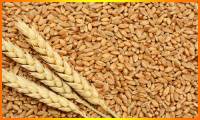
India s wheat, rice stocks comfortable to meet needs, says Food Ministry.
India’s wheat and rice stocks in the Central Pool is comfortable at over 57.9 million tonnes (mt) and the country can meet its foodgrain requirements, the Food Ministry said on Thursday. 'The combined stock position of wheat and rice in the Central pool is over 57.9 mt (wheat 31.2 mt and rice 26.7 mt) which has placed the country in a comfortable position to meet its requirements of food grains,' the Ministry said in a statement.
The situation is better than as of May 1 when the Central pool stocks were 55.53 mt with wheat making up 29.02 mt and rice 26.5 mt. In addition to rice and wheat, the Food Corporation of India, which maintains the Central pool, holds 22.69 mt of paddy (which can yield 14.52 mt of rice) and 0.5 mt of coarse grains.
Six-year low
The stocks are well above the mandatory norm of 21.04 mt for the period, including strategic reserves of 3 mt of wheat and 2 mt of rice. However, the Central pool stocks are at a 6-year low with wheat stocks at 15-year low and rice at 4-year low. The Ministry said the procurement of rice is going on smoothly, while that of wheat 'has progressed smoothly'.
The FCI has procured 38.5 mt of rice till May 30 during the kharif marketing season with another 11 mt set to be purchased further. In addition, 10.6 mt rice has been estimated to be procured during the rabi marketing season,' it said. The progressive procurement of wheat is 26.3 mt till May 30, surpassing last year’s purchase of 18.8 mt. The procurement has ended in some of the key States.
About 21.27 lakh farmers have benefited from the wheat procurement at the minimum support price (MSP) of ?2,125 a quintal resulting in an outflow of about ?47,000 crore for the government. Major contributions in the wheat procurement came from Punjab, Madhya Pradesh and Haryana with procurement of 12.13 mt, 7.09 mt and 6.32 mt, respectively.
The government’s decision to relax quality specification in wheat, which were affected due to untimely rains, and opening up of procurement centres in village and panchayat level helped in 'healthy procurement', the Ministry said.
Procurement through co-operative societies, gram Ppanchayats and arhatiyas (commission agents) and engaging farmer producer organisations for the Central pool purchase were additional factors that aided the Centre.
Source: thehindubusinessline.com

World Milk Day: Dairy farmers pledge to work for making India the Dairy of the World .
Dairy farmers and their families committed themselves towards making India the ‘Dairy of the World’ on the occasion of World Milk Day saying that the only way forward to alleviate rural India from poverty and bring about socio-economic change is by working towards establishing the country as the global leader in the dairy sector.
On the occasion, the dairy farmers members of 22 milk producer companies (farmer producer organisations) came together and committed themselves to make India ‘Dairy of the World’ by increasing the country’s share of the total global production; ‘provide quality milk and milk products to consumers by sourcing milk even from the remotest part of the country’; provide a competitive price to farmer members through a fair and transparent process of milk collection and making payments in their respective bank accounts and increase milk productivity through breed improvement programmes and better animal management practices.
Speaking at the occasion, Meenesh Shah, Chairman of National Dairy Development Board (NDDB) said, 'The world dairying community only months back paid rich tributes to rural India and dairy farmers at the World Dairy Summit 2022. We are part of this proud community of milk producers and are working on numerous initiatives for enhancing production and productivity in India towards making India the dairy of the world.'
During the World Milk Day celebrations, from distant Tirupati in Andhra Pradesh to coastal Gujarat to spreads of Rajasthan to the hinterlands of Uttar Pradesh and Bihar, the dairy farmers took the pledge and thanked the government for outlining the way forward by giving them a cherished goal of making the country a global leader to attain the target of 33 per cent market share in the decade to come.
It is pertinent to note that India’s collective drive towards ‘Dairy of the World’ has women empowerment ingrained into it, as out of 22 milk producer companies (MPCs) supported by NDDB Dairy Services (NDS), 15 have all-women membership and all the producer directors’ on their Boards too are women. These 22 MPCs spread across 130 districts in nine states of the country, have 8.7 lakh members and 71 per cent of them are women.
Source: agriculturepost.com

Huge opportunities will open up when exports touch $2 trn by 2030: Goyal.
Commerce and Industry Minister Piyush Goyal on Thursday said huge opportunities for people and businesses will be opened up when the country's goods and services exports touch USD 2 trillion by 2030.
In the last two years, he said the country's exports jumped from USD 500 billion to USD 767 billion in 2022-23.
India is a USD 3.5 trillion-economy today and will become at least USD 35 trillion- economy by 2047 and 'imagine what opportunities it will open up for all the people of India,' he said.
According to him, by 2030, 'we will see USD 2 trillion of exports from India, imagine the opportunities that it will open up'.
At the Times Network India Economic Conclave here, the minister also said the country's economy is growing at a faster pace and it is clearly reflected from the 7.2 per cent GDP growth in 2022-23.
'India is in the mode of stability with a proactive government strengthening every element of the economy in a manner which will hold us in good stead in our pursuit to make India a developed nation by 2047,' he said, adding that 'this is the work in progress'.
India's exports contracted by 12.7 per cent, third month in a row, to USD 34.66 billion in April due to the global demand slowdown even as the trade deficit reduced to a 20-month low of USD 15.24 billion, according to the government data.
Source: business-standard.com

Negotiations for the Supply Chains (Pillar-II) Agreement substantially concluded during 2nd IPEF Ministerial Meeting.
Negotiations for the Supply Chains (Pillar-II) Agreement were substantially concluded during the second in-person Indo-Pacific Economic Framework (IPEF) Ministerial Meeting held in Detroit on 27 May 2023, hosted by the US.
Once implemented, the Supply Chain Agreement is expected to bring in a number of benefits to India and the other IPEF partner countries. Some of the key benefits expected are: potential shift of production centres in key goods/critical sectors to India; bolstering of domestic manufacturing capacities; giving a boost to Aatmanirbhar Bharat and Production Linked Initiatives schemes; mobilization of investments especially in production of key goods, logistics services and infrastructure; deeper integration of India in the Global Supply and Value Chains particularly of Indian MSMEs; enhanced exports from India; upward mobility in the value chains; mitigation of risks of economic disruptions to India from supply chain shocks/adverse events; creation of a seamless regional trade ecosystem facilitating flow of Indian products; enhanced trade facilitation including through digital exchange of trade documentation, quicker port clearances; joint Research and Development; and workforce development.
India and other partner countries will continue to engage to ensure effective implementation of the Agreement so as to achieve the overall objectives of the Agreement which is to make IPEF supply chains more resilient, robust, and well-integrated, and contribute towards economic development and progress of the region as a whole.
The IPEF Supply Chains (Pillar-II) Agreement is one of the fastest ever concluded plurilateral economic cooperation Agreements. Under this Agreement, IPEF partner countries are seeking to: make supply chains more resilient, robust, and well-integrated through crisis response measures; cooperation for mitigation of the effect of disruptions to better ensure business continuity, and improve logistics and connectivity; promoting investments particularly in critical sectors and production of key goods; and worker role enhancement through requisite upskilling and reskilling, and increasing comparability of skills credentials frameworks across IPEF. It entails cooperative and collaborative efforts among the IPEF partners.
Source: pib.gov.in

Indian sugar mills export entire quota of 6.1 million tonnes.
Indian mills have shipped out the entire 6.1 million tonnes of sugar allowed for exports, industry officials told Reuters, cashing in on multi-year high prices in the world market and robust demand.
The world's second-biggest producer of the sweetener is, however, unlikely to allow additional exports in the current marketing year ending on Sept. 30, due to a likely drop in production.
This could lift global prices , and allow top producer Brazil to sell more sugar on the world market.
'The mills have shipped the entire allocated quantity, and nothing has left since global prices became attractive,' Prakash Naiknavare, managing director of the National Federation of Cooperative Sugar Factories Ltd, told Reuters.
Mills were getting more than 50,000 rupees ($604.6) per tonne from the overseas sale against the local price of 36,500 rupees, dealers said.
A rumour earlier this month that India could ban exports prompted mills to accelerate the remaining shipments, he said.
The country exported a record 11 million tonnes of sugar in the previous 2021-2022 season, but New Delhi allowed exports of only 6.1 million tonnes in the current year due to an expected drop in production.
Production is likely to fall to 32.8 million tonnes in the current year, from a record 35.8 million tonnes in the previous season.
The drop in the production has closed the window of additional exports, which mills were seeking earlier, said a senior industry official, who declined to be named.
'We are now not demanding the government to allow more exports in the current season. We know it's not possible,' he said.
India mainly exports sugar to Indonesia, Bangladesh, Malaysia, Sudan, Somalia and the United Arab Emirates.
Asian and African buyers have shifted to Brazil from India as the south American country has ample surplus for exports, said a Mumbai-based dealer with a global trade house.
Source: reuters.com

Karnataka government to set up Nandini dairy-like farmers' produce stalls across state.
Karnataka Agriculture Minister Chaluvarayaswamy announced on May 30 that similar to Nandini stalls across the state, vegetable stalls will also be introduced. Called Amrutha Malige (Amrita Shops), these will sell the local farmers' produce and will come up next to the Nandini stalls.
While Nandini stalls sell dairy products, Amrutha Malige will sell vegetables. He told the media that a pilot project of two stalls had been carried out and following its success, this will now be implemented in all the districts of Karnataka.
AGRICULTURE POSTS TO BE FILLED
Chaluvarayaswamy also told the media that there were about 58% of posts in the agriculture department that were lying vacant. The government will now decide whether to hire permanent employees or employees on contract to fill these posts. There were 8,982 posts in the agriculture department and about 5,195 posts are lying vacant.
The minister added that there had been a delay in informing farmers about the programmes of the agriculture department as there are more than 3000 posts vacant.
MEET FARMERS' NEEDS FOR SOWING SEASON
The agriculture minister has also directed his department to ensure that all the farmers' needs are met before the sowing season. He stated that quality seeds, fertilisers and other items would be made available to farmers before the sowing season.
Source: indiatoday.in

Government to build foodgrain godowns in every block.
The government will introduce the 'world’s largest foodgrain storage scheme' with warehouses in every block in the country under cooperative societies for an allocation of approximately Rs 1 lakh crore, minister Anurag Thakur told reporters after aCabinet briefing on Wednesday.
The scheme will utilise funds already allocated for other schemes, Thakur said. Under this scheme, a godown of a capacity of 2000 tonnes will be constructed in every block, or district subdivision. An inter-ministerial committee will be formed for this. The initiative will help reduce damage of foodgrains due to a lack of storage, check distress sales by farmers, reduce import dependence, and create employment opportunities in rural India, the minister said.
It will boost food security in the country apart from helping farmers realise better prices for their goods and reducing transportation cost, he said.
Besides storing their produce in the facilities, farmers will also be able to get up to 70% loans from these cooperative societies. The programme will be launched as a pilot in 10 districts, and then taken to rest of country. It aims to raise India’s foodgrain storage capacity by 70 million tonnes in the cooperative sector. Currently, grain storage capacity in the country is about 145 million tonnes. In the next five years, this will expand to 215 million tonnes, Thakur said.Creation and operation of infrastructure for storage of grains, such as godowns, will be undertaken by primary agricultural credit societies and block federations.
Source: economictimes.indiatimes.com

Ministry of Agriculture & Farmers Welfare organises One Day National Workshop on 'Per Drop More Crop'.
A National Workshop on 'Per Drop More Crop (PDMC)' was organised by Department of Agriculture& Farmers Welfare (DA&FW), Ministry of Agriculture & Farmers Welfare, Government of India here today to discuss with the stakeholders the various approaches which can be adopted for increasing penetration of micro irrigation in the country. Participants from various Ministries/ Department of Central Government, States and UT’s, Irrigation Industries, Startups working in water management sector and Farmers Producer Organisations were present in the event.
Shri Manoj Ahuja, Secretary, Department of Agriculture & Farmers Welfare (DA&FW) inaugurated the event. He emphasised on adoption of technologies in implementation of the programmes and focused approach for enhancing micro-irrigation coverage and thereby increasing overall efficiency and water productivity of agriculture for ensuring food and nutrition security of the country and incomes of the farmers, particularly in rainfed areas. Dr. Himanshu Pathak, Secretary, Department of Agricultural Research & Education (DARE) also addressed the inaugural session. He urged all participants to make efforts for adoption of micro-irrigation on large scale for reducing water footprint of agriculture sector.
Shri Franklin L Khobung, Joint Secretary, Ministry of Agriculture & Farmers Welfare explained in detail the Per Drop More Crop (PDMC) Scheme and the progress made so far. It was informed that Department of Agriculture, Farmers Welfare (DA&FW) is implementing a Centrally Sponsored Scheme of Per Drop More Crop (PDMC) from 2015-16 in all the States of the country which focuses on enhancing water use efficiency at farm level through Micro Irrigation viz. Drip and Sprinkler irrigation systems. An area of 78 lakh ha has been covered under Micro Irrigation from 2015-16 to till date which is about 81% more than the area covered during pre-PDMC 8 years. The Government has been focusing on increasing water productivity in agriculture and thereby sustainable agriculture and incomes of farmers. A Micro Irrigation Fund (MIF) with a corpus of Rs. 5000 Crore has been created with NABARD during 2018-19 with major objective to facilitate the States in mobilizing the resources to provide top up/additional incentives to farmers for incentivising micro irrigation beyond the provisions available under Per Drop More Crop as well as innovative integrated projects including projects in the Public Private Partnership (PPP) for expanding Micro-irrigation. A Budget announcement has been made to double the initial corpus of Micro Irrigation Fund under NABARD, by augmenting it by another Rs. 5,000 crores.
During the programme, five Best Gram Panchayats from States of Andhra Pradesh, Gujarat, Rajasthan, Maharashtra and Tamil Nadu were recognised for their efforts in high micro-irrigation adoption and best practices in water management sector. Besides, leading States in the micro-irrigation shared the practices and innovative methods being followed in their States for enhancing the micro-irrigation coverage and their popularity among farmers. Leading experts from Ministry of Jal Shakti flagged the need and strategies to cover micro-irrigation in irrigated commands as well as emphasised its effectiveness in Ground Water management and sustenance. The representative from NABARD elaborated on various financing options available for expanding micro-irrigation in the country. Micro Irrigation industry members expressed their active support for the efforts being made by the Government in this national priority programme.
Shri Franklin L Khobung, Joint Secretary, Ministry of Agriculture & Farmers Welfare also held discussion with stakeholders on the draft revised guidelines for implementation of PDMC Scheme. During the discussion, he highlighted the role of different stakeholders in the successful implementation of the scheme. He emphasised the need of taking steps by State/UT Govts. in streamlining the implementation procedure and also on the role of MI industries in achieving the objectives of the scheme.
Source: pib.gov.in

Record production of rabi crops push up agri growth to 3-year high in Q4.
Record production of the main rabi crops — wheat and mustard — has led to a 12-quarter high growth rate of 5.5 per cent in agriculture and allied activities in the fourth quarter (Q4) of 2022–23 (FY23), compared with an upwardly revised 4.7 per cent in the third quarter (Q3).
The three-year record gross value added (GVA) growth in agriculture and allied activities came in despite a high base of 4.1 per cent in Q4 of the previous year, 2021–22 (FY22).
The growth for the major part of the primary sector was higher than 4.3 per cent for Q4FY23, as projected by the Second Advance Estimates.
Part of the reason for higher growth is the Revised Estimates of rabi production in the Third Advance Estimates of agriculture, which belied fears of unseasonal rains having caused damage to crops, particularly wheat.
The Third Advance Estimates showed that wheat production in the rabi season was expected to be a record 112.74 million tonnes (mt), which would be 5.5 per cent higher than last year’s production on the back of a sharp rise in acreage and higher yields. February’s Second Advance Estimates pegged it at 112.18 mt.
The production of mustard, the main oilseed grown during the rabi season, was projected at a record 12.49 mt, which is 4.43 per cent more than last year’s.
However, the Third Advance Estimates showed that the production of chana (gram), which is the biggest among the pulses grown in the country, would be 13.54 mt in FY23, which is the same as last year’s.
'The 5.5 per cent Q4 agriculture GVA growth came on a high base effect of 4.1 per cent a year ago. This was unlike Q3. This meant that while heatwaves destroyed wheat crops in Q4FY22, there was no such impact this time around,' said Devendra Pant, chief economist, India Ratings & Research.
Before this, agriculture and allied activities growth was higher at 6.8 per cent in Q4 of 2019–20. At that time, it was the major contributor, along with the government-induced public administration, defence, and services, to producing 3.7 per cent GVA growth in a sluggish economy.
This time, construction, trade, hospitality, and transport services too played a role in jacking up GVA growth to 6.5 per cent in Q4FY23, notwithstanding slowing down public administration, defence, and services sectors.
The Q4 growth in agriculture and allied activities, along with revised Q3 growth, produced a reasonable 4 per cent growth for the sector for FY23, regardless of dismal performance in the first (Q1) and second (Q2) quarters. The growth rate had stood at 3.5 per cent in FY22.
The Q3 growth in this sector was revised upwards to 4.7 per cent — a full 1 percentage point up from what was disclosed in February.
Meanwhile, the deflators in agriculture and allied activities fell from 5.1 per cent in Q3FY23 to 4.8 per cent in Q4.
Deflators are used to convert current prices into constant prices and represent the rate of inflation. Deflators were as high as 11.1 per cent in Q2 and 11.9 per cent in Q1.
While 4.8 per cent is not such a bad number for farmers, it is a reasonable inflation rate for customers too. However, deflators are mostly taken from wholesale prices rather than consumer prices. The effect of wholesale prices on consumer prices came with a lag.
The Consumer Price Index-based inflation rate for food items has already started coming down in March and April to 4.79 per cent and 3.84 per cent, respectively.
Source: business-standard.com

Global goods trade indicates possible turnaround in second quarter of 2023, says WTO.
Global goods trade is expected to witness a turnaround in the second quarter of this year due to a recent pickup in export orders, the WTO said on Wednesday. According to the WTO's Goods Trade Barometer, preliminary data suggest that trade remained depressed in the first quarter of 2023.
'But the recent pickup in export orders points to an increase in demand for traded goods in the second quarter,' it added.
These results are broadly consistent with the WTO's most recent trade forecast issued on April 5, which projects 1.7 per cent growth in world merchandise trade in 2023.
The WTO's (World Trade Organisation) expectation augurs well for India, which is struggling to push its outbound shipments.
India's exports contracted by 12.7 per cent, the third month in a row, to USD 34.66 billion in April even as the trade deficit reduced to a 20-month low of USD 15.24 billion, the government data showed.
Source: economictimes.indiatimes.com